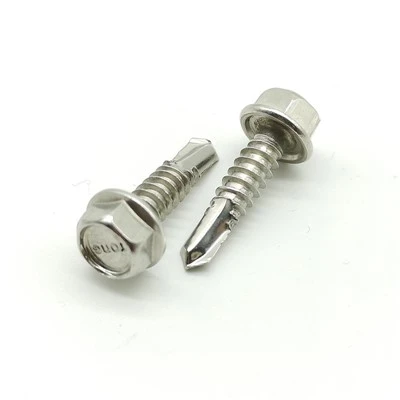
1. Choose the appropriate self-tapping screw type based on the substrate
Thin metal sheets (e.g., steel, aluminum): Use threaded self-tapping screws, which are formed by extrusion and suitable for materials with good ductility.
Hard or thick plate materials (e.g., stainless steel, thick aluminum): Use thread-cutting self-tapping screws, which have a cutting edge at the end and can cut threads like a tap.
Plastics or composite materials: Choose dedicated self-tapping screws with wide thread profiles and large lead to reduce radial stress and prevent cracking.
Scenarios where pre-drilling is not required: Use self-drilling self-tapping screws (drill-tail screws) directly, which integrate drilling, tapping, and fastening, improving efficiency.
2. Pre-treat the installation location
Clean the surface of oil, dust, and rust to ensure the contact surface is flat and clean, avoiding stripping or misalignment during screwing.
For harder materials (such as metal), it is recommended to pre-drill holes with a diameter slightly smaller than the screw diameter (usually 0.1-0.3 mm smaller) to reduce screwing resistance and prevent screw breakage.
3. Correct Screwing Procedure
Maintain Perpendicularity: Ensure the screw is perpendicular to the mounting surface during screwing. Tilting can cause thread misalignment, poor engagement, or even stripping.
Control Force and Speed: Screw slowly initially, gradually increasing speed after initial thread engagement.
Avoid excessive force, especially when using power tools. Adjust the torque appropriately to prevent stripping or material breakage.
Symmetrical Tightening for Multiple Connections: When fixing panels or chassis, use a crisscross tightening sequence to ensure even force distribution and prevent deformation.
4. Auxiliary Measures to Enhance Connection Reliability: Use washers (flat washers or spring washers) to distribute pressure, prevent the screw head from sinking into soft substrates, and provide anti-loosening protection.
Pre-coated screws (such as those with nylon adhesive) activate the bonding layer upon screwing in, achieving a dual mechanical and chemical locking mechanism.
In vibrating environments, self-locking self-tapping screws are preferred, as their thread root has a deformation zone, providing stronger resistance to loosening.