


Jiangyin Xianggu Hardware Products: a Leading Professional Hex Nuts Manufacturer in China
We have specialized in manufacturing various types of Hex Nuts for many years. By doing business with us, you can gain:
Complete Product Range
Our company can provide various stainless steel, carbon steel, copper Hex Bolts, Flange Bolts, Hex Socket Head Screws, Hex Nuts, Spring Washers, Flat Washers and other fasteners. We also offer a variety of coating treatments, such as hot-dip galvanizing, Dacromet, blue-white zinc, yellow zinc.
Professional Management System
Our company is committed to integrating the advantageous supply chain system of various fastener products, focusing on the sales staff's mastery of professional knowledge of fasteners, and aims to provide customers with fastener system solutions.
Rich Experience
We have been working with customers from various countries and industries for many years, so the experience is very rich. We are willing to be your partner with first-class product quality, first-class service level and competitive price.
Wide Range of Product Applications
Our fasteners are widely used in automobiles, ships, wind energy, solar energy, boilers, electronic appliances, mechanical equipment, construction engineering and other fields.
-
![Automotive Hex Flange Nuts]() Automotive Hex Flange NutsAutomotive Hex Flange Nuts are an important part of any vehicle assembly. They play a key role in holding various car parts together, ensuring the smooth and safe operation of the vehicle.
Automotive Hex Flange NutsAutomotive Hex Flange Nuts are an important part of any vehicle assembly. They play a key role in holding various car parts together, ensuring the smooth and safe operation of the vehicle. -
![Galvanized Heavy Hex Nut]() Galvanized Heavy Hex NutGalvanized Heavy Hex Nut is a heavy-duty hex nut with a galvanized finish. It is a common fastener used to connect bolts and threaded rods to provide a secure connection and support.
Galvanized Heavy Hex NutGalvanized Heavy Hex Nut is a heavy-duty hex nut with a galvanized finish. It is a common fastener used to connect bolts and threaded rods to provide a secure connection and support. -
![Carbon Steel Hexagon Hex Nut]() Carbon Steel Hexagon Hex NutCarbon Steel Hexagon Hex Nut is a common hex nut made of carbon steel. Carbon steel is a strong, wear-resistant material, so this nut offers great durability and reliability.
Carbon Steel Hexagon Hex NutCarbon Steel Hexagon Hex Nut is a common hex nut made of carbon steel. Carbon steel is a strong, wear-resistant material, so this nut offers great durability and reliability. -
![Hot-dip Galvanized Hex Nuts]() Hot-dip Galvanized Hex NutsHot-dip galvanized hex nuts are an excellent choice for a variety of industrial and outdoor applications. These nuts are coated with a layer of zinc to prevent rust and corrosion, making them
Hot-dip Galvanized Hex NutsHot-dip galvanized hex nuts are an excellent choice for a variety of industrial and outdoor applications. These nuts are coated with a layer of zinc to prevent rust and corrosion, making them -
![Heavy Duty Hex Nuts]() Heavy Duty Hex NutsHeavy Duty Hex Nuts are an important component in many construction and engineering projects. They are designed to provide a secure, long-lasting connection between two or more components.
Heavy Duty Hex NutsHeavy Duty Hex Nuts are an important component in many construction and engineering projects. They are designed to provide a secure, long-lasting connection between two or more components. -
![Carbon Steel Heavy Hex Nut]() Carbon Steel Heavy Hex NutCarbon Steel Heavy Hex Nut is an important component in many construction and engineering projects. These nuts are strong, durable and capable of withstanding heavy loads, making them the perfect
Carbon Steel Heavy Hex NutCarbon Steel Heavy Hex Nut is an important component in many construction and engineering projects. These nuts are strong, durable and capable of withstanding heavy loads, making them the perfect -
![Stainless Steel Thin Hex Nuts]() Stainless Steel Thin Hex NutsStainless Steel Thin Hex Nuts are an excellent choice for fastening applications where space is limited. These nuts are made from high-quality stainless steel, ensuring excellent durability and
Stainless Steel Thin Hex NutsStainless Steel Thin Hex Nuts are an excellent choice for fastening applications where space is limited. These nuts are made from high-quality stainless steel, ensuring excellent durability and -
![Carbon Steel Zinc Plated Hex Nut]() Carbon Steel Zinc Plated Hex NutCarbon steel zinc plated Hex nuts are critical components in a variety of industrial and mechanical applications. Designed with six sides that make it easier to tighten and loosen with a wrench or
Carbon Steel Zinc Plated Hex NutCarbon steel zinc plated Hex nuts are critical components in a variety of industrial and mechanical applications. Designed with six sides that make it easier to tighten and loosen with a wrench or -
![Stainless Steel Galvanized Nut]() Stainless Steel Galvanized NutStainless Steel Galvanized Nut is a type of fastener widely used in various industries due to its excellent durability and corrosion resistance. These nuts are made of high-quality stainless steel
Stainless Steel Galvanized NutStainless Steel Galvanized Nut is a type of fastener widely used in various industries due to its excellent durability and corrosion resistance. These nuts are made of high-quality stainless steel -
![Stainless Steel Hexagon Nut]() Stainless Steel Hexagon NutStainless Steel Hexagon Nut is a fastener widely used in various industries. It is made of stainless steel, known for its excellent corrosion resistance, durability and strength. These qualities make
Stainless Steel Hexagon NutStainless Steel Hexagon Nut is a fastener widely used in various industries. It is made of stainless steel, known for its excellent corrosion resistance, durability and strength. These qualities make -
![High Strength Heavy Hex Nuts]() High Strength Heavy Hex NutsHigh Strength Heavy Hex Nuts are commonly used in the construction, manufacturing and mechanical industries for their durability and resistance to wear and tear. These nuts are designed to withstand
High Strength Heavy Hex NutsHigh Strength Heavy Hex Nuts are commonly used in the construction, manufacturing and mechanical industries for their durability and resistance to wear and tear. These nuts are designed to withstand -
![High Strength Heavy Hex Nut]() High Strength Heavy Hex NutHigh Strength Heavy Hex Nut is a high-strength nut typically used in applications where large loads and pressures are required. It is made of high-strength materials, usually alloy steel or stainless
High Strength Heavy Hex NutHigh Strength Heavy Hex Nut is a high-strength nut typically used in applications where large loads and pressures are required. It is made of high-strength materials, usually alloy steel or stainless


Hex nuts are six-sided hexagonal nuts used to tighten bolts and screws. One of the most common hex fasteners, they have internal threads that thread onto the shank of a hex head screw or other bolt. Hex nuts are often used with hex head bolts. However, its uses are not limited to hex head bolts. The hexagonal body allows for easy tightening while applying sufficient torque to the bolt joint. Hex nuts can be used with a variety of bolts. Their dimensions are defined in both metric and imperial sizes.

Reasonable Design
Hex nuts provide good angular granularity to the tool, which is especially helpful when one is working in tight spots. You'll find hex nuts in furniture, building frames, children's toys, automobiles, and household appliances. If the nut has more than six sides, it may crack or break. Six sides are ideal! As a result, hex nuts have become a universally accepted standard, used by consumers and businesses around the world.

Easy to Twist
Hex nuts are easy to turn because they have six parallel lines. Since a hex nut has six sides, one can turn the fastener one-sixth to reach the next parallel. If one uses a square nut, they have to turn it a quarter each time to get to the next parallel. A sixth turn is faster and easier than a quarter turn.

Durability
Hex nuts are available in zinc, plain, stainless steel, and galvanized finishes for long-lasting durability. Their materials can be carbon steel, stainless steel and other types of metals, so they have excellent corrosion resistance and wear resistance to adapt to harsh industrial and commercial environments.

Strong Versatility
These hex nuts can be used with all types of machine threaded fasteners, including anchors, bolts, screws, studs and threaded rods. Hex nuts are used with other fasteners, usually bolts, to close or complete a fastening. Therefore, these nuts can be used in almost any application that requires fasteners.
Benefits of Hex Nuts
These are six-sided fasteners with internal threads designed to mate with external threads of bolts or screws. They provide a secure and tight fit, preventing the loosening or disconnection of fastened components. These are also available in various materials, such as steel, stainless steel, brass, and nylon, offering versatility to meet specific application requirements.
Secure Fastening
One of the primary functions of hex nuts is to ensure secure fastening. By mating with the external threads of bolts or screws and create a stable connection, preventing the loosening or separation of assembled components. The hexagonal shape of the nut allows for easy and efficient tightening using a wrench or a socket, providing adequate torque for a secure fit.
Load Distribution and Joint Integrity
It distributes the load evenly across the threaded joint, enhancing the strength and stability of the assembly. They create a larger contact surface area between the fastener and the components, reducing the risk of localized stress concentrations. This load distribution capability helps maintain the integrity of the joint, even under heavy loads or dynamic forces.
Versatility and Compatibility
These are widely used in various industries due to their versatility and compatibility with different fasteners. They can be used in conjunction with bolts, screws, or studs of corresponding size and thread pitch. This versatility allows for easy interchangeability and adaptability, making hex nuts a popular choice for a wide range of applications.
Common Materials and Surface Treatments for Hexagonal Nuts
Commonly Used Materials
Steel, stainless steel, brass, silicon bronze, aluminum and nylon are common materials used to make hex nuts. Steel and stainless steel are cheaper, and copper alloys such as brass and silicon bronze are the most expensive. In rare cases, it may be necessary to use special materials such as titanium or super duplex steel. When corrosion is a concern, 316 stainless steel is preferable to the often specified 304 stainless steel material. Because 316 stainless steel provides adequate protection for most applications in salty environments.
Common Surface Treatment Methods
Galvanizing and hot-dip galvanizing are common surface treatments for hexagonal nuts. Galvanizing is the most common and cheapest commercial electroplating and offers a moderate level of corrosion resistance. When hot-dip galvanized, the strong zinc coating protects hex nuts from corrosion in harsh environments. It is worth mentioning that when evaluating coating and finishing applications, engineers should be aware of compatibility issues between plating and nut materials.

6 Common Types of Hex Nuts
All hex nuts have a hexagonal shape. They may have circular threads on the inside, but always have a hexagonal shape on the outside. Here are the 6 most common hex nut types.

Standard Hex Nut
Flange Hex Nut
Slotted Hex Nut
Capped Hex Nut
Nylon Nut
Wing Nut
Applications of Hex Nuts
Hex nuts can be used in numerous industries and projects, from construction to manufacturing. Some common applications include:
Hex nuts are widely used in the automotive industry to secure various components including bolts, screws and other fasteners. They play a vital role in maintaining the structural integrity of the vehicle.
Hex nuts are often used in conjunction with bolts in construction to fasten beams, columns and other load-bearing elements. They maintain the stability of the building structure.
In the assembly of machinery and equipment, hexagonal nuts are used to secure moving parts and ensure the normal operation of the mechanism. They provide stability and prevent loosening.
Hex nuts can also be used in electronic manufacturing, particularly for securing components on circuit boards. They provide reliable, durable fastening solutions for electronic equipment.
High-precision hex nuts can be used to fasten components in aircraft and spacecraft. They contribute to the overall safety and performance of aerospace systems.
In the construction of renewable energy infrastructure such as wind turbines and solar panels, hex nuts are used to secure components and ensure the stability of these installations.
The rail industry utilizes hex nuts to assemble and maintain rail tracks and related infrastructure. They are able to withstand harsh operating conditions to provide durability and reliability.
Importance of Hex Nut in Construction
Hex nuts play a crucial role in construction by providing a secure and reliable fastening solution for a wide range of applications. Some of the key benefits and importance of hex nuts in construction include:
Strength: Hex nuts provide a strong and secure fastening solution that can hold objects together with great force, making them ideal for use in heavy-duty construction projects.
Versatility: Hex nuts can be used in a variety of applications, from securing lumber and metal to attaching fixtures and hardware.
Ease of Use: Hex nuts can be easily tightened or loosened with a wrench, making them a convenient and accessible fastening solution for construction projects.
Durability: Hex nuts are typically made from strong and durable materials, such as steel, which can withstand high levels of stress and strain, and can resist corrosion and wear.
Cost-effectiveness: Hex nuts are an affordable fastening solution that offer excellent value for money, making them a popular choice for construction projects of all sizes.
Factors to Consider When Choosing the Right Hex Nut
The hex nuts and bolts you choose mainly depend on your project. For example, if you are an automotive fleet manager or use heavy dock equipment, you may need larger, corrosion-resistant hex nuts and bolts. However, if you're a woodworker who holds a table saw or maintains hand tools, you may need lighter, smaller hex nuts and bolts. Here are 3 important things to consider when choosing hex nuts and bolts:
Material Options
The most commonly used material in hex fastener construction is carbon steel because of its durability and ability to perform well even at high temperatures. But hex nuts and fasteners can be made from many different materials, so choosing the right material is crucial. Other materials you can consider for hex nuts include: alloy steel, aluminum, stainless steel (recommended for applications in high-humidity areas), bronze, and brass (commonly used in corrosive areas).
Thread Type and Count
After deciding on the material of your hex fastener, the next step is to choose the correct thread type. If you are assembling equipment such as a pump or forklift, you may want to use hex nuts and bolts with coarse threads. On the other hand, if your goal is better thread engagement, a fine-thread hex nut may be a better choice.
Environmental Exposure
Before making your final choice, consider what conditions your hardware and equipment will be exposed to. Will they be exposed to high temperatures? Or will they be corroded by high pressure and corrosive liquids? This may cause loose connections. Salt water and extreme cold can also affect machinery and fasteners. Vibration from factors such as misaligned shafts or mechanical design is another consideration.
By following these steps, you can ensure that your hex nut remains in good condition and performs its function effectively. To maintain a hex nut, follow these steps:
Clean the Nut: Use a clean cloth or brush to remove any dirt, rust, or debris that may have accumulated on the surface of the nut.
Lubricate: Apply a thin layer of oil or grease to the threads of the nut to prevent corrosion and make tightening and loosening easier.
Tighten: Use the appropriate wrench or pliers to tighten the nut to the specified torque. Over-tightening can damage the nut or the bolt, while under-tightening can lead to the nut becoming loose.
Inspect: Regularly inspect the nut for signs of wear, corrosion, or damage. If any issues are found, replace the nut as needed.
Store Properly: Store nuts in a dry, cool place to prevent corrosion and extend their lifespan.

Introduction to Nut and Bolt Sizes
When discussing nut and bolt sizes, it is not only important to understand the differences between inch and metric fasteners, but to also understand which measurements are essential to determining the sizes of the nuts and bolts you need for your applications. All sizes of nuts and bolts fall into one of two main categories: standard/inch and metric . While it may seem natural to look for imperial nut and bolt sizes when searching for fasteners measured in inches, the industry does not use this term. Instead, you will find standard, inch, or U.S. fasteners. Fortunately, metric is the only industry term for fasteners measured in millimeters.
Differences Between Inch and Metric Nuts and Bolts
While the functionality and physical characteristics of inch and metric nuts and bolts are essentially the same, how they are sized is different. The sizes are communicated by key measurements, standards, and strength grade markings. The biggest difference between nut and bolt inch and metric sizes is how measurements are defined. While each type of nut or bolt will have its own set of characteristics to measure, every fastener is measured by its thread diameter and threads per inch (TPI) or thread pitch.
-Thread Measurements
Regardless of inch or metric measurements, thread diameter is defined by either the outside diameter (OD) or the inside diameter (ID) of the part:
*Outside Diameter (OD) or Major Diameter
Nuts: the distance between the roots of the threads.
Bolts: the distance between the crests of the threads.
*Inside Diameter (ID) or Minor Diameter
Nuts: the distance between the crests of the threads.
Bolts: the distance between the roots of the threads.
The OD is more commonly used in basic measurements. The thread measurement depends on the measurement system in use:
*Threads Per Inch (TPI): used to measure inch fasteners — how many threads are present in an inch of the thread length.
*Thread Pitch: used to measure metric fasteners — the distance between two thread crests, given in millimeters.
Measurement Format for Size Names
Nut and bolt size names, regardless of the measurement system, are always given as the OD followed by the TPI or thread pitch . The names within each measurement system will look slightly different.
-Inch Format
The measurement of an inch nut or bolt will be listed as the thread size — a number between one and 12 or an inch increment followed by the threads per inch (TPI). If the diameter is less than 1/4 inch, the diameter will be listed as a number between zero and 12; the larger the number, the closer it is to 1/4 inch. When the diameter is equal to or larger than 1/4 inch, it will be listed as an inch increment. The TPI, or number of threads within an inch of the thread length, will immediately follow the diameter.
-Metric Format
The thread size of a metric nut or bolt is listed as the letter "M" followed by a number that indicates the number of millimeters across the diameter and then the thread pitch.
Coarse and Fine Threads
Nut and bolt size names will sometimes also factor in whether the thread is coarse or fine. Simply put, coarse threads are thicker and farther apart from each other, while fine threads are thinner and closer together. There are a few acronymns that are used to designate each thread type:
-Standard Coarse Threads
*UNC: Unified National Coarse threads comparable to ISO metric threads
*UNRC: Unified National Coarse threads; the "R" indicates "rolled" external threads that have a rounded root contour. They are full interchangeable with UNC fasteners.
*UNJC: Unified National Coarse threads with an increased minor diameter and controlled root radius that disperses tensile strength over a broader area. Derived from a military specification (MIL-S-8879), they are designed for high stress applications. However, they are not interchangeable with other UNC fasteners.
-Metric Coarse Threads
ISO metric threads will simply use the word "coarse."
-Standard Fine Threads
*UNF: Unified National Fine threads.
*UNRF: Unified National Fine threads; the "R" indicates "rolled" external threads that have a rounded root contour. They are fully interchangeable with other UNF fasteners.
*UNJF: Unified National Fine threads with an increased minor diameter and controlled root radius that disperses tensile stress over a broader area. Derived from a military specification (MIL-S-8879), they are designed for high stress applications. However, they are not interchangeable with other UNF fasteners.
-Metric Fine Threads
ISO metric threads will simply use the words "fine" or "super fine."
Sometimes, you will see the same thread size listed twice, each with a different thread pitch or TPI next to them. For example:
*M2.3 x 0.45 vs. M2.3 x 0.4: These have the same diameter, but the thread pitch in the first measurement is larger than the second one, so the distance between threads will be bigger.
*10 - 24 vs. #10 - 32: These have the same diameter, but the TPI in the first measurement is lower than the second one, so there will be fewer threads per inch of thread length.
Because TPIs and thread pitches are calculated differently, remember the following:
*Inch Threads: A higher TPI indicates finer threads as there are more threads within an inch of thread length.
*Metric Threads: A lower thread pitch indicates finer threads as there is less space between each thread crest.
Standards
Nuts and bolts are regulated by standards, depending on their measurement system.
-Inch Standards
Most inch nuts and bolts comply with the Unified Thread Standard (UTS). The American Society of Mechanical Engineers (ASME) and The American National Standards Institute (ANSI) regulate this standard. Additionally, the Society of Automotive Engineers (SAE International) regulates standards for parts used in automotive applications. If any of the following standards apply to your nuts or bolts, you are working with inch fasteners:
*UTS: Unified Thread Standard for screw threads commonly used in the U.S. and Canada including Unified National Coarse (UNC) and Unified National Fine (UNF) threads. ASME/ANSI - Specifies screw thread properties for three classes of general purpose unified screw threads including: UN, UNR, and UNJ series fasteners.
*SAE: A standard that designates the number of threads per inch for coarse and fine American (or standard) bolts, screws, pipes, ports, and flange ports.
-Metric Standards
For metric nuts and bolts, the most common standards are:
*ISO: Strict specifications for coarse, fine, and superfine metric threads defined by the International Organization for Standardization.
*DIN: Standards defined by the German Institute for Standardization for thread styles commonly used in Europe.
-ASTM
The American Society for Testing and Materials (ASTM) standard covers both inch and metric nuts and bolts. We'll discuss how to identify the appropriate measurement system in the following section.
Strength Grade Markings
Sometimes, manufacturers mark their nuts and bolts with indentations to indicate the strength of the fastener. Different standards use different strength markings, but there are a few markings you are most likely to encounter.
-Inch Grade Markings
Inch nuts regulated by the SAE will have lengthwise lines within the circle on the top of the nut, while bolts will have lines on the bolt head moving from the center of the head outwards.
-Metric Grade Markings
If a nut or bolt shows numbers instead of line indentations to indicate their strength grade, it is a metric fastener. However, depending on the fastener's standard, metric nuts can also show a pattern of lines and dots between the circle and the sides of the nuts. Metric nuts will print these indentations outside the circle.
-ASTM Grade Markings
You may also come across bolts with alphanumeric marks, typically an "A," "B," or "F" in combination with one to four numbers. This mark could exist on its own or along with lines. This is an ASTM strength grade mark. If this mark is followed by a capital "M," that signifies that the fastener is metric. If there is no "M" present, it is an inch fastener.
Manufacturers are not required to mark their fasteners with strength grades, so this is not a guaranteed method of identifying the inch or metric designation of your fastener. Many nuts and bolts will only imprint the manufacturer's brand mark, which may be a simple letter and should not be confused with a strength grade.
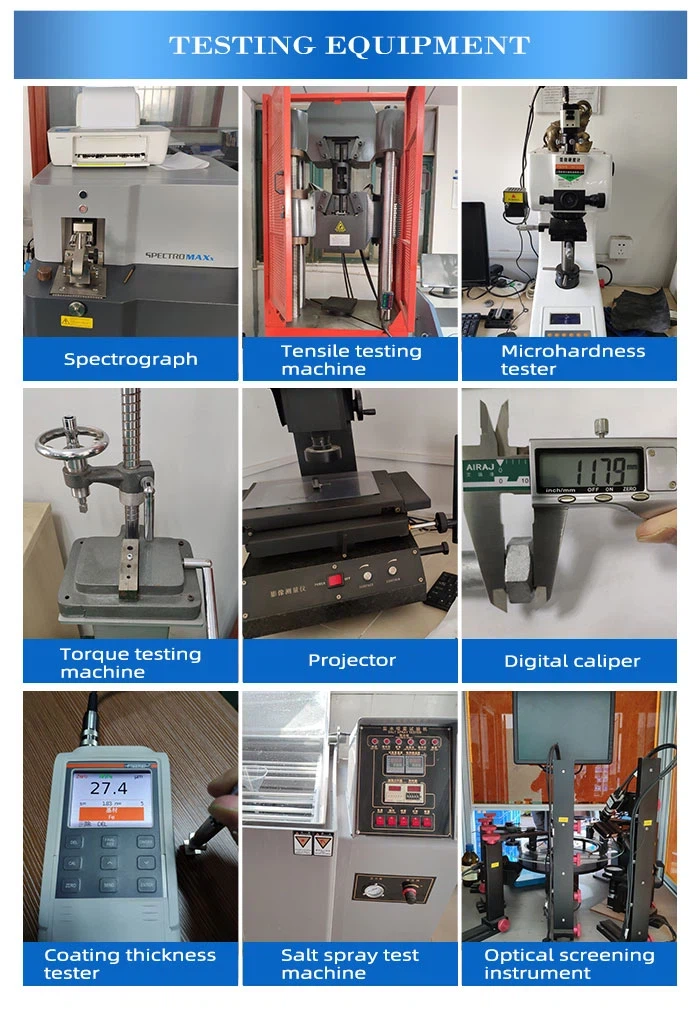
Testing Equipment
We use the following equipment to test our products to ensure they meet high quality standards:
Factory Photos
The picture below is our production workshop:

Frequently Asked Questions
Q: What are the advantages of a hex nut?
Q: What is the difference between a nut and a hex nut?
Q: What is an alternative to a hex nut?
Q: What are the most widely used fasteners?
Q: Are hex nuts and lock nuts the same?
Q: Is a hex nut a locking nut?
Q: What is the difference between a hex nut and a bolt?
Q: Are finished hex nuts fasteners?
Q: Can hexagonal nuts be welded?
Q: Are hexagonal bolts fully threaded?
Q: How to tighten hex nuts?
Q: What is the difference between a lock nut and a hex nut?
Q: Are hex nuts magnetic?
Q: What type of threads do hex nuts have?
Q: Can I use bolts without hex nuts?
Q: Are surface treated hex nuts more corrosion resistant?
Q: What is the maximum torque I can apply to a hex nut?
Q: What does the flange hex nut look like?
Q: Are hex nut sizes standardized?
Q: Can hex nuts be used in corrosive environments?
Q: What does "Hex Nut M24" mean?
Q: What is the largest hex nut?
Q: What is the difference between hex nut of style 1 & 2?
●Height: Style 1 hex nuts are typically higher than Style 2 hex nuts and provide a greater grip surface.
●Strength: Style 2 hex nuts are often designed to be stronger and provide greater holding power than Style 1 nuts.
●Threads: Style 1 and Style 2 nuts may have different thread patterns and pitch, which can affect their compatibility with different bolts.
●Material: The material used to make Style 1 and Style 2 nuts can also be different, which can affect their strength, corrosion resistance, and overall performance.
As one of the most professional hex nuts manufacturers and suppliers in China, we're featured by customized hardware products made in China. Please rest assured to buy or wholesale high quality hex nuts for sale here from our factory. For price consultation, contact us.
hex nut brass, acme hex nut, m6 1.25 nutPopular Products


