


Jiangyin Xianggu Hardware Products: a Leading Professional Flange Bolts Manufacturer in China
We have specialized in manufacturing various types of Flange Bolts for many years. By doing business with us, you can gain:
Complete Product Range
Our company can provide various stainless steel, carbon steel, copper Hex Bolts, Flange Bolts, Hex Socket Head Screws, Hex Nuts, Spring Washers, Flat Washers and other fasteners. We also offer a variety of coating treatments, such as hot-dip galvanizing, Dacromet, blue-white zinc, yellow zinc.
Professional Management System
Our company is committed to integrating the advantageous supply chain system of various fastener products, focusing on the sales staff's mastery of professional knowledge of fasteners, and aims to provide customers with fastener system solutions.
Rich Experience
We have been working with customers from various countries and industries for many years, so the experience is very rich. We are willing to be your partner with first-class product quality, first-class service level and competitive price.
Wide Range of Product Applications
Our fasteners are widely used in automobiles, ships, wind energy, solar energy, boilers, electronic appliances, mechanical equipment, construction engineering and other fields.
-
![Hex Half Thread Flange Bolt]() Hex Half Thread Flange BoltThe hex half thread flange bolt is a type of fastener commonly used in a variety of industries, including construction, automotive, and machinery.
Hex Half Thread Flange BoltThe hex half thread flange bolt is a type of fastener commonly used in a variety of industries, including construction, automotive, and machinery. -
![Stainless Steel Hex Head Flange Bolts]() Stainless Steel Hex Head Flange BoltsStainless steel Hex Head Flange Bolts are a type of fastener commonly used in a variety of applications. They are designed with hex head and bottom flange.
Stainless Steel Hex Head Flange BoltsStainless steel Hex Head Flange Bolts are a type of fastener commonly used in a variety of applications. They are designed with hex head and bottom flange. -
![Metric Hexagon Flanged Bolts]() Metric Hexagon Flanged BoltsMetric Hexagon Flanged Bolts are an important component in a variety of engineering, industrial and construction applications. These bolts feature a hex head for superior grip and allow for easy
Metric Hexagon Flanged BoltsMetric Hexagon Flanged Bolts are an important component in a variety of engineering, industrial and construction applications. These bolts feature a hex head for superior grip and allow for easy -
![Stainless Steel Flange Bolt]() Stainless Steel Flange BoltStainless Steel Flange Bolts are an essential part of many industrial and mechanical applications. They are used to hold two or more components together and play a key role in the overall safety and
Stainless Steel Flange BoltStainless Steel Flange Bolts are an essential part of many industrial and mechanical applications. They are used to hold two or more components together and play a key role in the overall safety and -
![Stainless Steel Flanged Hex Bolts]() Stainless Steel Flanged Hex BoltsStainless Steel Flanged Hex Bolts are a reliable and popular fastener for a variety of applications. Made of high-strength stainless steel, these bolts are corrosion-resistant and able to withstand
Stainless Steel Flanged Hex BoltsStainless Steel Flanged Hex Bolts are a reliable and popular fastener for a variety of applications. Made of high-strength stainless steel, these bolts are corrosion-resistant and able to withstand -
![Hex Flange Head Bolts]() Hex Flange Head BoltsHex flange head bolts, also known as hex flange bolts or flanged hex bolts, are a type of fastener commonly used in a variety of industries and applications.
Hex Flange Head BoltsHex flange head bolts, also known as hex flange bolts or flanged hex bolts, are a type of fastener commonly used in a variety of industries and applications. -
![Class 8.8 Steel Flanged Hex Head Screws]() Class 8.8 Steel Flanged Hex Head ScrewsThese Class 8.8 Steel Flanged Hex Head Screws are suitable for fastening most machinery and equipment. The flange distributes pressure where the screw meets the surface, eliminating the need for a
Class 8.8 Steel Flanged Hex Head ScrewsThese Class 8.8 Steel Flanged Hex Head Screws are suitable for fastening most machinery and equipment. The flange distributes pressure where the screw meets the surface, eliminating the need for a -
![Hex Flange Bolts]() Hex Flange BoltsHigh-Strength Metric Class 10.9 Steel Flanged Hex Head Screws. Choose these Class 10.9 steel screws for high-stress applications, such as valves, pumps, motors, and automotive suspension systems..
Hex Flange BoltsHigh-Strength Metric Class 10.9 Steel Flanged Hex Head Screws. Choose these Class 10.9 steel screws for high-stress applications, such as valves, pumps, motors, and automotive suspension systems..


Key Features of Flange Bolts
Customizable
Flange bolts come in a variety of sizes, styles, and materials, allowing you to tailor their use to your specific needs. The most common type is the hex head flange bolt, which has a 6-sided head that can be easily connected using an open-end or socket wrench. This flange bolt also features a small head that reduces its profile while providing maximum grip between the connected components.
High Strength
Flanges provide greater strength than traditional nuts or washers because they distribute the load evenly over the entire surface area of the bolt head. This helps prevent slippage or loosening over time, making it ideal for applications where vibration or other factors may cause traditional fasteners to loosen or become misaligned. Additionally, its unique design eliminates the need for separate washers or nuts, reducing assembly time and cost while increasing efficiency.
Easy to Maintain
Because flanges are made from metal alloys such as steel or stainless steel, they are highly resistant to corrosion and other wear and tear caused by moisture or extreme temperatures. This makes them an excellent choice for outdoor applications where regular maintenance is not possible or feasible due to environmental conditions such as wind, rain, snow, etc.
Wide Range of Applications
Flange bolts can be used in many industries. They are most commonly used in automotive and construction applications to hold two or more objects together. For example, the automotive industry uses it to connect exhaust systems to vehicles and to secure pipes. They are typically made from carbon steel or stainless steel and are designed to maintain excellent performance in harsh industrial environments.
Different Types of Flange Bolts
Socket Head Flange Bolt
Socket head flange bolts are used when a higher clamp load is needed than can be achieved with a standard hex bolt. The socket head design allows the fastener to be driven into place with a wrench or driver bit instead of using a tool like a ratchet or Allen key. Socket head flange bolts are commonly used in applications with limited access space, such as automotive engine compartments, machinery and equipment, and other tight spaces.
Round Head Flange Bolt
Round-head flange bolts provide a larger surface area than socket-head bolts and are often used when more torque must be applied during installation or removal. These flanges are also known as 'button' heads due to their round shape, making them easier to tighten by hand if necessary. Round head flanges tend to have a lower profile than socket head styles, making them ideal for use in applications where low-profile fasteners are needed, such as in furniture assembly or electronics manufacturing.
Flat Head Flange Bolt
Flat head flanges feature a flat surface on top that helps distribute the load evenly over a wider area than other types of fasteners. They are commonly used in applications that require tamper-resistant fasteners or where flush-mounting is desired, such as equipment panels or doors. Flat-head flanges have slimmer profiles when compared to round heads, allowing them to fit into tighter spaces while still providing adequate strength and stability.

Surface Treatments for Flange Bolts
Plain
Plain flange bolts have no surface treatment. They are often used in applications where the bolts will not be exposed to corrosive elements.
Zinc Plated
Zinc plating is a common surface treatment that provides a layer of zinc on the surface of the bolt. This layer offers excellent corrosion resistance.
Zinc Flake
Zinc flake is a type of coating that provides excellent corrosion resistance. It is often used in automotive applications.
Phosphate
Phosphate coating is a type of surface treatment that provides excellent corrosion resistance and reduces friction. It is often used in automotive and construction applications.
YZP
YZP, or Yellow Zinc Plated, is a type of zinc plating that has a yellow passivation layer. This layer provides additional protection against corrosion.
Top 5 Applications of Flange Bolts
Flange bolts provide the same bonding strength as washers, although in some applications they can be used with regular bolts equipped with washers. Flange bolts are available in a variety of materials, including anodized aluminum and zinc chromate, and are commonly used in the following applications.
To ensure a reliable, long-lasting connection between two parts of a large, enclosed area, you need to use flange bolts. The best example of this situation is the connection between the transmission and the engine in a vehicle. Both the engine and transmission have multiple moving parts that can be easily damaged when small objects, debris, or dirt get inside them. In this case, the purpose of the flange bolts is to secure the housing and protect the engine and gearbox. Another common application for flange bolts in the automotive industry includes automotive exhaust systems. Automobile exhaust flange bolts and springs replace traditional bolts and washers, ensuring increased strength and reliability.
When trying to join two pipes together, plumbers have several options. Without denying the efficiency of welding pipes together, cylinders fastened by either method are more likely to burst when exposed to high pressure. A safer way to join pipes together is to secure their ends with flange bolts. This way, plumbers can ensure the pipe will hold regardless of the type of gas or liquid inside it.
Fasteners in electronic equipment are not designed to withstand high voltages. However, they still have to hold the small parts tightly inside to prevent particles from entering the device and damaging sensitive parts. As you might guess, these types of flange bolts are much smaller than the flange bolts used to join pipes or fasteners used in the automotive industry. If you're curious about what they look like, check out the camera: The small fasteners that connect the camera body to the lens glass are flange bolts.
Whenever you're forced to work in a tight, inaccessible, and dark place, you want to use as few tools and materials as possible. In these cases, flange bolts can save you a lot of trouble and time. For example, using flange bolts when installing a second-story deck can save you the hassle of dealing with small regular bolts and washers while still trying to use the tools correctly.
Long flange bolts, especially those with a length of 30 cm are often used in large machinery applications. Similar to other types of flange bolts, these slender fasteners are available in a variety of shaft diameters and are used in the construction of oil rigs, energy plants, manufacturing plants, large automobiles and ships.
Why are Flange Bolts better than Standard Hex Products
Washers have traditionally been used to protect the joint surface from damage during the tightening process and to distribute the load under the bolt head and nut. The stress under the face of a standard hexagon headed nut can result in indentation into standard strength steel surfaces. In recent years washers have started to be replaced by flanged headed fasteners for several reasons that will be discussed in this article. Prior to going into the details, lets look at some background.
Using torque to indirectly control a bolt’s tension is by far the most popular controlled tightening method. This is due to its simplicity and its widespread understanding by the majority of engineers.The nominal torque necessary to tighten the bolt to a given tension can be determined either from tables, or, by calculation using a relationship between torque and the resulting bolt tension, or by testing. Friction that acts in the threads of the bolt and under the bolt head dissipates the majority of the tightening torque. For a free spinning nut, only about 15% of the torque is actually used to extend the bolt. The majority of the torque is used to overcome friction under the nut face and in the threads.
The way in which this can affect replacement fasteners is that the original equipment manufacturers (OEMs) specify the tightening torque based upon tests or calculations on the fasteners that are installed on the equipment. Many OEMs specify flanged headed fasteners for a number of reasons. Using a replacement fastener not of the same type, strength and finish as that originally specified will lead to potentially serious problems since the torque-tension characteristics will be affected. That is, the preload generated by the tightening torque may be insufficient to prevent the joint or the bolt failing.
Flanged headed nuts and bolts have been developed to eliminate the deficiencies that have been found with the use of washers. Standard washers are typically softer than the nuts and bolts that they are used with and can often plastically deform under the high compressive stress that they must sustain. For higher strength fasteners, this can lead to the washer dishing and indenting resulting in the clamp force being reduced significantly. Flange headed nuts and bolts do not suffer from this effect since the washer face is as strong as the bolt/nut itself. It is not unusual for short grip length joints, with several interfaces, to experience a bolt tension reduction of up to 50%. A joint that may perform satisfactorily when flanged nuts and bolts are used may suffer problems when washers are inserted into the joint. Such a change can invalidate all the calculations and testing pertaining to the joint completed by the manufacturer.
Using a plain hexagon headed nut and bolt without washers will increase the surface pressure under the bolt head and nut face well beyond that which a standard structural steel surface can adequately support. The consequence of this is that the amount of embedding loss is significantly increased resulting in a higher than anticipated bolt tension loss. Essentially the risk is that for short grip length joints, the bolts can come loose without nut rotation occurring. The adverse effect that this can have on the joint’s structural integrity is obvious.
As has been explained, there are several reasons as to why flanged nuts and bolts are preferred over standard hexagon fasteners used with washers. The sensible approach is to replace like fasteners with like fasteners; unless you are feeling lucky.
How to Select the Right Flange Bolts for Your Project
When it comes to ensuring the success and safety of any construction or engineering project, choosing the right flange bolts is as important as any other decision. The following content will guide you in selecting the perfect flange bolts for your project.
There are many different types of flange bolts. Some flange bolts with a serrated design are ideal for applications where vibration may cause the connection to loosen, as the serrations prevent loosening. Other flange bolts are better suited for applications that may require frequent adjustment or replacement of bolts. Therefore, it is important to choose the right type for your project.
The material of a flange bolt can significantly affect its strength and suitability for a specific environment. Stainless steel bolts are known for their corrosion resistance, making them ideal for use outdoors or in high-humidity environments. Carbon steel bolts are known for their strength and are often used in heavy-duty applications. Coatings like zinc or black oxide add an extra layer of corrosion resistance that can extend the life of your bolts.
Choosing the correct size and knowing the tensile strength is crucial. Dimensions should be determined based on the thickness of the material being joined. The tensile strength (indicated by the grade on the bolt) will determine the amount of load the bolt can handle and also ensure that the bolt is strong enough for your project.
The specific application of the bolt should guide your selection. For automotive applications, bolts that can withstand high temperatures and vibrations are critical. In construction, bolts that support heavy loads and are weather-resistant would be more appropriate. Always consider environmental conditions, such as exposure to chemicals or extreme temperatures.
Flange bolts should comply with industry standards such as ISO or DIN. These standards ensure that bolts are manufactured to a certain quality and are safe for use in specified applications. Therefore, using bolts that meet standards is not only a matter of quality, but also of safety and regulatory compliance.

How to Remove the Exhaust Flange Bolts
The changing temperatures from cold to hot of the exhaust system together without changing the moisture conditions can result in speeding up the rusting of the flange bolts. If the rust progresses, it could reach the threads, and these may go useless. It is essential to replace and release the flange bolts. You need to apply heat to remove the rust from the threads. If the threads are unusable, you need to cut the bolts from the flange.Here are a few easy steps to remove the exhaust flange bolts easily:
●Keep a check if the area on the flange bolts has no fuel lines as well as combustibles. Clearance of all the combustibles underneath the vicinity for safety is essential.
●Use gloves and goggles to protect your hands and eyes. It is better to have a fire extinguisher closer in case the fire starts. Ignite the torch carefully. Make sure that the bright blue flame is half or one inch long.
●The tip of the torch must be 6-8 inches away from the flange bolt until it has a dull orange color. You need to turn off your torch. Heat the bolt slowly and do not use air to trigger it.
●It is better to let the flange bolt cool down and place the socket that fits the bolt to the ratchet.
●Slide the socket to the nut that is at the flange bolt. If the bolt loosens, continue with the same process for the rest of the bolts. If it doesn’t budge, go to the next step.
●Keep the tip 3-4 inches further and set the flames again.
●Heat the bolt once again and when it turns to a bright orange glow, use the air to trigger and blow out more oxygen. Bolt would then start to meltdown.
●Turn your torch off and quickly hammer the threaded side of the flange bolt. Repeat the process until the bolt is out of the exhaust.
●Let the hot bolt cool down for around thirty minutes. Make sure no combustible materials are lying around before you leave the area.
●Throw the cut bolts after another hour or two to ensure that the bolts are at room temperature and won’t cause fires in the garbage bin.

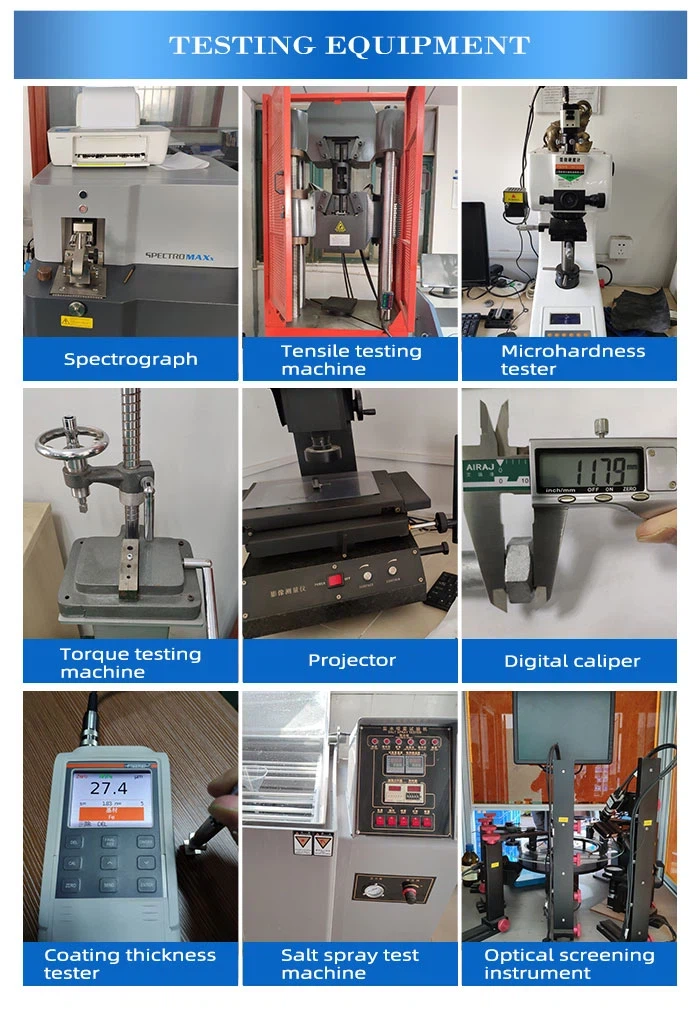
Testing Equipment
We use the following equipment to test our products to ensure they meet high quality standards:
Factory Photos
The picture below is our production workshop:

Ultimate Guide
Q: What are flange bolts?
Q: What is DIN 6921?
Q: What materials are used for flange bolts?
Q: What are the different surface treatments available for flange bolts?
Q: What is the strength of flange bolts?
Q: What can Grade 8 Hex Flange Bolts be used with to increase strength?
Q: Do flange bolts require washers?
Q: What is the torque load of flange bolts?
Q: What happens when flange bolts are overtorqued?
Q: What happens if the flange bolts are not tightened correctly?
Q: What are the common failures of flange bolts?
Q: Do flange bolts weaken over time?
Q: Where do flange bolts fail due to tension?
Q: What causes flange bolts to break?
Q: How do you know if a flange bolt is a high tension bolt?
Q: Why do flange bolts stretch?
Q: What are flange bolts used for?
Q: What types of materials are flange bolts made from?
Q: Are there any safety considerations when using flange bolts?
Q: What are some common applications for flange bolts?
Q: How does a flange bolt differ from a standard bolt?
As one of the most professional flange bolts manufacturers and suppliers in China, we're featured by customized hardware products made in China. Please rest assured to buy or wholesale high quality flange bolts for sale here from our factory. For price consultation, contact us.
m10 x 1 25 stainless flange bolt, food processing plant flange bolts, pipe flange boltsPopular Products


