


Jiangyin Xianggu Hardware Products: a Leading Professional Flat Washers Manufacturer in China
We have specialized in manufacturing various types of Spring Washers for many years. By doing business with us, you can gain:
Complete Product Range
Our company can provide various stainless steel, carbon steel, copper Hex Bolts, Flange Bolts, Hex Socket Head Screws, Hex Nuts, Spring Washers, Flat Washers and other fasteners. We also offer a variety of coating treatments, such as hot-dip galvanizing, Dacromet, blue-white zinc, yellow zinc.
Professional Management System
Our company is committed to integrating the advantageous supply chain system of various fastener products, focusing on the sales staff's mastery of professional knowledge of fasteners, and aims to provide customers with fastener system solutions.
Rich Experience
We have been working with customers from various countries and industries for many years, so the experience is very rich. We are willing to be your partner with first-class product quality, first-class service level and competitive price.
Wide Range of Product Applications
Our fasteners are widely used in automobiles, ships, wind energy, solar energy, boilers, electronic appliances, mechanical equipment, construction engineering and other fields.
-
![Square Flat Spring Washer]() Square Flat Spring WasherSquare Flat Spring Washer, also known as Square Spring Washer or Square Section Washer, is a mechanical component used in a variety of applications to provide a secure, tight connection between two
Square Flat Spring WasherSquare Flat Spring Washer, also known as Square Spring Washer or Square Section Washer, is a mechanical component used in a variety of applications to provide a secure, tight connection between two -
![Flat Spring Washer With Square Ends]() Flat Spring Washer With Square EndsFlat Spring Washer With Square Ends is a highly versatile and effective tool for any application requiring a safe and secure fastening solution.
Flat Spring Washer With Square EndsFlat Spring Washer With Square Ends is a highly versatile and effective tool for any application requiring a safe and secure fastening solution. -
![Heavy Washer]() Heavy WasherWith our expertise in this field, we are able to manufacture and supply high-quality Heavy washers. Our products are made of high-quality materials sourced from the most trusted and reliable
Heavy WasherWith our expertise in this field, we are able to manufacture and supply high-quality Heavy washers. Our products are made of high-quality materials sourced from the most trusted and reliable -
![Flat Washer]() Flat WasherA flat washer is a thin ring with a circular outer diameter and a central hole (inner diameter), and its size is only larger than a bolt or screw.
Flat WasherA flat washer is a thin ring with a circular outer diameter and a central hole (inner diameter), and its size is only larger than a bolt or screw. -
![Countersunk Washers]() Countersunk WashersCountersunk Washers are made of stainless steel. These turned washers are ideal for design/aesthetic sensitive applications. Unlike standard flat washers, they have a tapered countersunk hole for the
Countersunk WashersCountersunk Washers are made of stainless steel. These turned washers are ideal for design/aesthetic sensitive applications. Unlike standard flat washers, they have a tapered countersunk hole for the -
![Spherical Washers]() Spherical WashersSpherical washers are designed to help uniform tightening between irregularly aligned parts. The top washer (C) has a convex spherical radius for alignment with the concave bottom washer (D).
Spherical WashersSpherical washers are designed to help uniform tightening between irregularly aligned parts. The top washer (C) has a convex spherical radius for alignment with the concave bottom washer (D). -
![Hardened Steel Washers]() Hardened Steel WashersHardened steel washers provide a smooth bearing surface for use under the heads of bolts and/or nuts.
Hardened Steel WashersHardened steel washers provide a smooth bearing surface for use under the heads of bolts and/or nuts. -
![Stainless Steel Flat Washers]() Stainless Steel Flat WashersUse these metric washers to evenly distribute the load under bolt or screw heads and nuts when fastening. They can also act as spacers.. Stainless steel washers are more corrosion resistant than
Stainless Steel Flat WashersUse these metric washers to evenly distribute the load under bolt or screw heads and nuts when fastening. They can also act as spacers.. Stainless steel washers are more corrosion resistant than -
![Carbon Steel Plain Washer]() Carbon Steel Plain WasherSteel washers are stronger and more wear resistant than stainless steel washers. Steel washers without a plating or coating are best for dry environments, since moisture will cause them to rust.
Carbon Steel Plain WasherSteel washers are stronger and more wear resistant than stainless steel washers. Steel washers without a plating or coating are best for dry environments, since moisture will cause them to rust. -
![Heavy Washers]() Heavy WashersDesigned for use with A325 structural screws, studs, and nuts, these washers are often used for construction and exterior building applications.. Hot-dipped galvanized washers are corrosion resistant
Heavy WashersDesigned for use with A325 structural screws, studs, and nuts, these washers are often used for construction and exterior building applications.. Hot-dipped galvanized washers are corrosion resistant -
![Oversized Washer]() Oversized WasherCompared to our general purpose washers, these have exaggerated diameters and/or thicknesses for covering oversized holes or for use as spacers and levelers.. Black-oxide steel washers have mild
Oversized WasherCompared to our general purpose washers, these have exaggerated diameters and/or thicknesses for covering oversized holes or for use as spacers and levelers.. Black-oxide steel washers have mild -
![Zinc SAE Washers]() Zinc SAE Washers316 stainless steel washers have excellent resistance to chemicals and salt water. They may be mildly magnetic.. 18-8 stainless steel washers have good chemical resistance and may be mildly magnetic.
Zinc SAE Washers316 stainless steel washers have excellent resistance to chemicals and salt water. They may be mildly magnetic.. 18-8 stainless steel washers have good chemical resistance and may be mildly magnetic.


Also known as plain washers, flat washers spread the load on a fastener while reducing heat and friction during the tightening process. Flat washers prevent the bearing surface from sinking under load, especially when the contact area of the fastening object is small and the fastening object is made of soft materials such as aluminum and resin. Flat washers are also used as gaskets, which are common in industrial and household applications. Such washers are available in metal and plastic materials. For electrical insulation, plastic flat washers are often used because metal washers act as conductors.

Strong Reliability
Flat washers are used to increase the bearing surface of a nut or fastener head, thereby spreading the clamping force over a larger area. They are useful when working with soft materials and oversized or irregularly shaped holes. The sturdy metal construction ensures long-term reliability in the application.

Various Materials and Surface Treatments
Flat washers are typically made from a variety of materials, including aluminum, brass, nylon, silicon bronze, stainless steel, and steel. Unplated or uncoated steel (called a "plain finish") has not been surface treated to prevent rust other than a thin layer of oil for temporary protection. Therefore, common steel surface treatments are galvanizing and hot-dip galvanizing.

Strong Durability
After surface treatment, these flat washers become more resistant to corrosion, ensuring long-term durability. For example, in a corrosive environment, stainless steel can form its self-healing, corrosion-resistant chromium oxide film when it encounters oxygen. This feature allows flat washers to play an important role in a variety of harsh industrial applications.

Various Sizes
The washer size refers to its nominal hole size and is based on the screw size. Its outer diameter (OD) is always larger. Dimensions and outside diameters are usually expressed in fractions of inches, but decimal inches may also be used. Thickness is usually listed in decimal inches. These sizes are customizable to your specific needs, meaning you can choose the right size flat washer for different applications.
Benefits of Flat Washers

Load Distribution
Prevent Leaks
Protection and Insulation
Enhance Grip and Reduce Vibration
Compensating for Oversized or Misaligned Holes
Different Types of Flat Washers
There are different types of flat washers suitable for different applications. See below for descriptions of each.
Fender Washers
Due to their large outside diameter (OD), fender washers provide an extra wide support surface, which is useful when working with oversized or irregularly shaped holes and when fastening soft materials that would benefit from added support.
Machine Screw Flat Washers
Machine screw flat washers are the smallest type of flat washers because their outside diameter (OD) is typically only slightly greater than twice their inside diameter (ID).
Mega Thick Flat Washers
Mega thick flat washers are extra thick, with thicknesses ranging from 0.100" to 0.313", making them useful for spacing applications. It is generally available in SAE and USS models.
SAE Flat Washers
SAE flat washers provide a tighter thread fit, are thinner, and have a smaller outside diameter (OD) than comparably sized USS washers. Hardened SAE flat washers with Grade 5 and 8 hex screws are recommended.
Square Plate Washers
Square plate washers are large, thick, and flat and are typically used in structural bolting applications.
Structural Flat Washers
Structural flat washers are used in exterior construction applications and in the construction of A325 bolts, studs and nuts.
Thick Flat Washers
Thick Flat Washers are thicker than standard washers and range in thickness from 0.072" to 0.146", which allows them to be used as gaskets. They are generally available in SAE and USS models.
T-Slot Washers
T-slot washers are flat washers with a beveled edge and approximately the same outside diameter (OD) as an equivalent SAE washer, but are approximately twice as thick as their SAE counterparts. T-Slot Washers are typically used with T-Slot Bolts but can also be used as gaskets due to their thickness. T-Slot Washers are heat treated (where indicated) for added strength.
USS Flat Washers
USS flat washers offer a looser thread fit, are thicker, and have a larger outside diameter (OD) than comparably sized SAE washers. The oversized holes in the USS washers are too large to properly support the bearing surfaces of Class 5 and Class 8 hex head screw heads, while the smaller one washer size will be too tight and may cause the screw head to fail.
Common Uses of Square Flat Washers
Washers are the fastening industries’ load distributors. When they’re manufactured as conservatively shaped discs, they protect the area around an inserted bolt by augmenting the diameter of that fastener head. Square flat washers serve the same purpose, but they also take that principle in a different direction. They’re shims and turn-resistant anchoring products. Having touched upon a few simple applications, just what are the common uses of square flat washers?
Squarish Shims Fill Space
That’s right, while disc washers are operating solely as load distributors, square flat washers are serving a second role. Their thick metal forms have that standard bolt opening in the centre, plus a wide surface area, a feature that spreads torque and head load, but they also perform as shims. That means the bolt crown can be lifted away from the anchored part. It also means that a multi surface project won’t deform or bend when the fastener is tightened, not when these shimming washers are interposed between more than two anchoring parts. If there is an open space in the coupling join, the zone between the bolt head and the nut at the other end of the fastener rod, the squared shim washers occupy that space and act as a force-countering join segment. Employed in the construction industry and complex parts mating scenarios, this bushing or packing feature keeps multiple join surfaces deform-free.
Non-Rotating Fixtures
When a narrow structural frame employs a restrictive series of elongated channels, there are advantages to be gained when the underlying fastener parts lock. Special locking nuts are half the battle here, yet there’s still that spinning washer disc to deal with, isn’t that right? Well, square flat washers solve that spinning headache by using their flat edges as an anchor. Placed below the bolt head and under the nut, the fastener is already partially locked. Just screw the nut tight to complete the fastener’s journey. Of course, this may sound like a rudimentary product attribute, but it’s one that becomes invaluable when square structural tubing is employed on a building project. Due to their flat sides, square flat washers are also commonly used in complex machine housings. High-vibration machinery, mine screening equipment and commercial washing machines, as just two examples of this application practice, use the flat, square fastener parts in restrictive spaces to ensure anchoring reliability, even when those vibrational forces try their best to loosen the bolt. Narrow vehicle crevices, square tubing, construction frame components, all of these applications and more benefit when shim-capable square flat washers are called into service.
Two Common Standards for Flat Washers

USS
The name USS is derived from the name of the "Unified Standard Series" when coarse threaded fasteners were also called USS bolts. Many people believe that USS flat washers are intended for use with "USS" coarse thread bolts. This is not the case and is incorrect for many applications. USS standard flat washers are suitable for applications involving compressible materials such as wood, thin sheet metal, etc. Their outside diameter is wide enough to provide a large surface area to prevent the bolt head from digging into the material and minimize joint compression. At the same time, their inner diameters are large enough to accommodate bolts with very loose tolerances.
SAE
Since the Industrial Revolution, more equipment and machines are made of steel, which is not as compressible as wood. Therefore, the smaller, more compact SAE standard flat washer was developed and named after the Society of Automotive Engineers. The inside diameter of an SAE flat washer is closer to the diameter of the bolt size it is mated to because today's bolts are manufactured by machine from cold forming to hot heading to tight tolerances. The SAE flat washer also has a smaller outside diameter because it does not require as large a load-bearing surface area to prevent compression as USS washers do for compressible materials.

Factors to Consider When Choosing the Right Flat Washer
When used with bolts and nuts, you should consider the following factors when choosing flat washers:
When selecting gasket materials, attention should be paid to the electrochemical corrosion of different metals. The material of the flat pad is generally the same as that of the connected parts, usually steel, alloy steel, stainless steel, aluminum alloy, etc. Copper and copper alloys can be used when conductive requirements are required.
The inner diameter of the flat washer should be selected based on the larger diameter of the thread or screw. The connection material should be soft (such as composite materials) or matched with spring washers, and a larger outer diameter should be selected.
When the washer is placed on the bolt or screw head, in order to prevent the fillet under the head from interfering with the washer, a flat washer with an inner hole chamfer can be used.
Steel flat washers should be used for important large diameter bolts or when increasing anti-extrusion force. Steel flat washers should also be used for tension bolt or tension-shear composite bolt connections. For special requirements, you should use special gaskets. For example, copper gaskets can be used for conductive parts, and sealing flat washers can be used for applications that require air tightness.
DIY Tips: When and How to Use Flat Washers Effectively
Flat washers might seem like small, inconspicuous pieces of hardware, but they play a crucial role in many DIY projects. Whether you’re assembling furniture, repairing household items or building a treehouse, knowing when and how to use flat washers can make all the difference in ensuring your projects are sturdy and long-lasting. The following content will cover some basic tips to help you use flat washers more effectively.
Understand Their Purpose
At their core, flat washers are designed to distribute the pressure of a nut or bolt evenly over a surface, preventing damage and ensuring a tighter fit. They also help reduce friction when tightening, and in some cases, they can prevent corrosion between dissimilar metals.
Select the Right Material
Flat washers come in a variety of materials including steel, stainless steel, brass, copper and even plastic. Your choice should depend on the application:
●Steel and Stainless Steel: Great for most general-purpose applications. Stainless steel offers better corrosion resistance.
●Brass and Copper: Typically used in situations where corrosion is a concern, or a softer metal is needed to prevent marring a surface.
●Plastic: Ideal for electrical insulation or when a non-conductive washer is required.
We would recommend using Stainless Steel as they offer the most beneficial features and it suits most projects.
Size is Key
Ensure your washer fits snugly around your bolt or screw. The inner diameter of the washer should be slightly larger than the diameter of your fixing. Too big, and it may not serve its purpose; too small, and it might not fit.
Layering Washers
In some DIY situations, you might find it beneficial to use multiple washers. This can provide extra spacing, distribution of pressure, or even added aesthetic appeal.
Use with Wooden Projects
When working with softwoods or thin pieces of lumber, flat washers are essential. They prevent bolts and screws from digging into the wood, which can weaken the material over time.
Prevention of Galvanic Corrosion
If you’re using a bolt of one metal and attaching it to a material of another metal, a washer can act as a barrier, preventing the two metals from reacting with each other.
Re-check Tightness After Time
Over time, as materials settle or are exposed to various environmental factors, the tightness of a bolt can change. Every so often, give a quick check to your bolted connections to ensure they’re still snug.
Storage Tips
Keep an organised collection of washers in various sizes and materials. This ensures you always have the right washer on hand for the job. Little compartmentalised storage boxes or magnetic trays can be handy for this purpose.
Washers in Motion
For any parts that will have movement (like a swinging gate or door), washers can help reduce wear over time by acting as a buffer between the moving parts.
When in Doubt, Use Them
If you’re unsure whether a washer is necessary, it’s typically better to use one. The added distribution of pressure and protection they provide is often worth the minor additional effort.
Difference Between Flat Washer and Spring Washer
Application Advantages

lat Washers
The main advantage of using flat washers is that they help distribute the load evenly across the surface material, thereby reducing the risk of damage or deformation. They are inexpensive and easy to source, making them ideal for low-cost applications. Additionally, they can be stacked together to form thicker gaskets for applications requiring additional thickness.

Spring Washers
The main advantage of spring washers is that they provide superior tension control, maintaining a tight connection even under vibration or movement. They are also better suited for high load applications as they are designed to withstand greater tension. Additionally, spring washers can be reused multiple times, which makes them ideal for repair work.
Design

Flat Washers
Flat washers are simple in design and consist of a flat, thin metal plate with a hole in the center. It is inserted via threaded fasteners. When a fastener is driven into an object, the flat washers will distribute its load. Regardless, they are flat. If the washer is flat, it is considered a flat washer.

Spring Washer
A spring washer is a washer with a curved shape. Unlike flat washers, they are not flat. The spring washer is curved. They can flex in different ways, but all spring washers have a curved shape that prevents them from sitting flush with the surface without load.
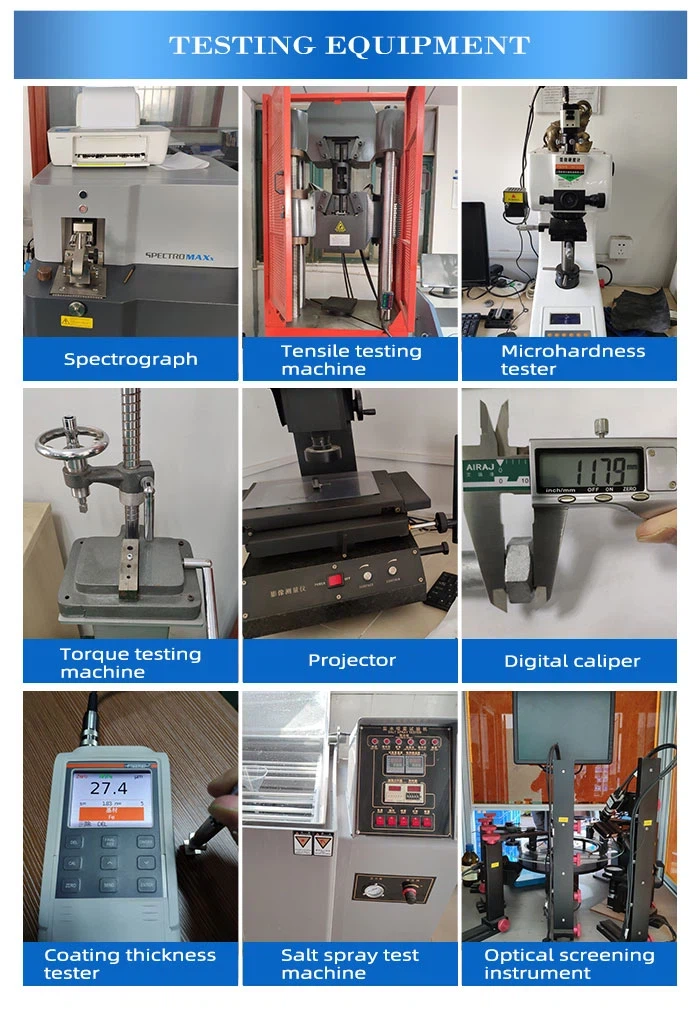
Testing Equipment
We use the following equipment to test our products to ensure they meet high quality standards:
Factory Photos
The picture below is our production workshop:

Frequently Asked Questions
Q: Should I use spring washers or flat washers first?
Q: Can flat washers prevent loosening?
Q: What are the three main types of washers?
Q: Are flat washers necessary?
Q: What are the most common standard flat washers?
Q: What is a stainless steel flat washer?
Q: Do flat washers have a direction?
Q: Are flat washers hardened?
Q: What are the common materials for flat washers?
Q: What are the sizes and specifications of flat washers?
Q: What is the difference between flat washers and lock washers?
Q: Why are flat washers necessary in some applications?
Q: What are the applications of flat washers in the automotive industry?
Q: How do you choose the right flat washer for a specific application?
Q: What is the smallest flat washer?
Q: Are there grades for flat washers?
Q: What are the dimensions of an M20 flat washer?
Q: Why choose flat washers?
Q: Why are washers used with screws?
Q: Why are washers used with bolts and nuts?
Q: How to use washers?
Q: When not to use washers?
●Your fastener has a large bearing surface.
●Vibration and other environmental factors aren’t a concern.
●Your joint has limited space for a washer.
●You can use a Place bolt instead.
As one of the most professional flat washers manufacturers and suppliers in China, we're featured by customized hardware products made in China. Please rest assured to buy or wholesale high quality flat washers for sale here from our factory. For price consultation, contact us.
rectangular flat washers, 4mm thick washers, special flat washersPopular Products


