


Jiangyin Xianggu Hardware Products: a Leading Professional Hex Bolts Manufacturer in China
We have specialized in manufacturing various types of Hex Bolts for many years. By doing business with us, you can gain:
Complete Product Range
Our company can provide various stainless steel, carbon steel, copper Hex Bolts, Flange Bolts, Hex Socket Head Screws, Hex Nuts, Spring Washers, Flat Washers and other fasteners. We also offer a variety of coating treatments, such as hot-dip galvanizing, Dacromet, blue-white zinc, yellow zinc.
Professional Management System
Our company is committed to integrating the advantageous supply chain system of various fastener products, focusing on the sales staff's mastery of professional knowledge of fasteners, and aims to provide customers with fastener system solutions.
Rich Experience
We have been working with customers from various countries and industries for many years, so the experience is very rich. We are willing to be your partner with first-class product quality, first-class service level and competitive price.
Wide Range of Product Applications
Our fasteners are widely used in automobiles, ships, wind energy, solar energy, boilers, electronic appliances, mechanical equipment, construction engineering and other fields.
-
![Stainless Steel Hex Cap Bolt]() Stainless Steel Hex Cap BoltStainless steel hex cap bolts are an important component in a variety of industries including automotive, aerospace and construction. They are used to secure two or more components together and
Stainless Steel Hex Cap BoltStainless steel hex cap bolts are an important component in a variety of industries including automotive, aerospace and construction. They are used to secure two or more components together and -
![Self Drilling Hex Head Screws]() Self Drilling Hex Head ScrewsSelf drilling hex head screws are an excellent choice for a variety of construction and DIY projects. These screws are designed to drill your own pilot holes, eliminating the need for pre-drilling
Self Drilling Hex Head ScrewsSelf drilling hex head screws are an excellent choice for a variety of construction and DIY projects. These screws are designed to drill your own pilot holes, eliminating the need for pre-drilling -
![Low Profile Hex Head Bolt]() Low Profile Hex Head BoltLow profile hex head bolt is a common fastener with a hexagonal head and threaded shaft. They are usually made of high-strength metal materials, such as carbon steel or stainless steel, to provide
Low Profile Hex Head BoltLow profile hex head bolt is a common fastener with a hexagonal head and threaded shaft. They are usually made of high-strength metal materials, such as carbon steel or stainless steel, to provide -
![Stainless Steel Hex Screws]() Stainless Steel Hex ScrewsStainless steel hex screws are a common fastener used to connect and secure a variety of materials. They are made of stainless steel and therefore have excellent corrosion resistance and durability.
Stainless Steel Hex ScrewsStainless steel hex screws are a common fastener used to connect and secure a variety of materials. They are made of stainless steel and therefore have excellent corrosion resistance and durability. -
![Stainless Allen Head Bolts]() Stainless Allen Head BoltsStainless Allen Head Bolts are a common type of bolt with a hexagonal head and internal hex hole for use with a hex wrench or wrench. They are usually made of stainless steel material, which makes
Stainless Allen Head BoltsStainless Allen Head Bolts are a common type of bolt with a hexagonal head and internal hex hole for use with a hex wrench or wrench. They are usually made of stainless steel material, which makes -
![Hex Washer Head Screw]() Hex Washer Head ScrewThe hex washer head screw is a fastener commonly used in a variety of applications. They feature a hex head with a flat gasket attached to the bottom, making them ideal for use in areas where a tight
Hex Washer Head ScrewThe hex washer head screw is a fastener commonly used in a variety of applications. They feature a hex head with a flat gasket attached to the bottom, making them ideal for use in areas where a tight -
![Hex Head Self Tapping Screw]() Hex Head Self Tapping ScrewA hex head self-tapping screw is a fastener designed to form its own threads when screwed into a material. They are typically used in applications where two materials need to be joined together
Hex Head Self Tapping ScrewA hex head self-tapping screw is a fastener designed to form its own threads when screwed into a material. They are typically used in applications where two materials need to be joined together -
![Stainless Steel Allen Head Bolts]() Stainless Steel Allen Head BoltsStainless Steel Allen Head Bolts are a common mechanical connecting element also known as screws or bolts. These bolts are made of high-quality stainless steel, ensuring durability and strength.
Stainless Steel Allen Head BoltsStainless Steel Allen Head Bolts are a common mechanical connecting element also known as screws or bolts. These bolts are made of high-quality stainless steel, ensuring durability and strength. -
![Hex Head Tap Bolts]() Hex Head Tap BoltsHex head tap bolts, also known as hex cap screws or hex head bolts, are a type of fastener commonly used in a variety of industries and applications. They are designed with a hex head and threaded
Hex Head Tap BoltsHex head tap bolts, also known as hex cap screws or hex head bolts, are a type of fastener commonly used in a variety of industries and applications. They are designed with a hex head and threaded -
![Flanged Hex Head Bolt]() Flanged Hex Head BoltFlanged hex head bolts are important fasteners used in a variety of applications. These bolts provide a safe and stable connection between two objects, helping to ensure that they stay in place and
Flanged Hex Head BoltFlanged hex head bolts are important fasteners used in a variety of applications. These bolts provide a safe and stable connection between two objects, helping to ensure that they stay in place and -
![Allen Key Head Bolts]() Allen Key Head BoltsThese bolts are available in a variety of sizes, lengths and materials to suit different needs. They come in both metric and imperial sizes, with the most common sizes being 3 mm to 10 mm (metric)
Allen Key Head BoltsThese bolts are available in a variety of sizes, lengths and materials to suit different needs. They come in both metric and imperial sizes, with the most common sizes being 3 mm to 10 mm (metric) -
![Stainless Hex Head Bolts]() Stainless Hex Head BoltsStainless Hex Head Bolts are versatile and essential components for construction and industrial projects. These bolts are the fastener of choice for many professionals because of their durability,
Stainless Hex Head BoltsStainless Hex Head Bolts are versatile and essential components for construction and industrial projects. These bolts are the fastener of choice for many professionals because of their durability,


Hex bolts are a type of threaded bolt characterized by a hexagonal head, so sometimes they are also called hexagonal head bolts. Hex bolts can be either fully threaded or partially threaded (having a clear shank along the main part). These fasteners are suitable for a variety of applications, usually mechanical and construction. They are available in a variety of types, sizes, materials and finishes, giving you the freedom and flexibility to choose the bolt that best suits your specific task or application.
Hexagonal bolts have a unique shape that makes them easy to identify. The main components of a complete hexagonal bolt include:

Hexagonal Head
The most distinctive feature of a hex bolt is its hexagonal (six-sided) head. This shape provides multiple points of contact, making it easier to grip and operate with a wrench or socket.

Threaded Shaft
The shaft of a hex bolt is threaded, which means it has spiral grooves that allow it to be screwed into a compatible threaded hole. Threads are critical to creating a secure, tight connection between two components.

Hex Nuts
Hex nuts are six-sided components with internally threaded holes. When the hex bolt is inserted into the parts that need to be fastened together, the hex nut is screwed onto the bolt from the other side. When the nut is tightened onto the bolt, it pulls the parts together, creating a strong connection. In some cases, a secure connection can be achieved using just a hex bolt, especially if the threaded hole the bolt is inserted into provides enough resistance to prevent the bolt from loosening easily.

Washers
Washers can also be used in conjunction with hex nuts and hex bolts. A washer is a flat, usually round, metal disc placed under a nut to spread the load and reduce the risk of damaging the surface of the material being fastened.
Key Features of Hex Bolts
Long Service Life
Hex bolts can be made from a variety of materials, including steel, stainless steel, brass, and bronze. This means they can withstand harsh temperatures, pressures and corrosive environments and provide a long service life.
Various Sizes
Hexagonal bolts are available in a variety of sizes, from small screws used to secure eyeglasses to large bolts used to secure heavy machinery. You can find hex bolts for almost any application.
Easy to Use
Hex bolts are designed with a hex head so they can be driven by a wrench or socket. Whether you want to adjust or remove them during use, it's easy to find the right tools to handle these bolts.
Thread Design
Hex bolts are often threaded, making them easier to install. The threads on them are usually right-hand, meaning they tighten when turned to the right and loosen when turned to the left.
Locking Feature
The resistance generated by the threads between the bolt and the nut or threaded hole provides a locking feature. This helps prevent the bolt from inadvertently loosening due to vibrations, impacts, or external forces.
Torque and Tightness
The torque applied to the bolt determines the level of tightness achieved in the connection. Proper torque ensures that the fastened components are securely held together without damaging the materials or the threads.
Advantages of Hex Bolts
Hexagonal bolts have a hexagonal head, which offers several advantages. For example, they are ideal for fastening applications in small spaces. For this reason, hexagonal bolts are often preferred in machines and equipment where space is limited.
Some bolts have square heads. The problem with square heads, however, is that they only have four sides. To loosen or tighten a bolt with a traditional wrench, you need to hold both sides of the wrench head. Hex heads have more sides than square heads, so they provide more surface for a traditional wrench to grip. This makes the hex bolts easier to install.
Hex bolts also allow for greater torque. Torque is rotational force. All bolts require turning to tighten or loosen. With a hex bolt, you will generate more torque due to its six-sided hex head. With more torque, you can remove hex bolts more easily than other types of bolts, including lag bolts.
You don't have to rely on a traditional wrench to tighten or loosen hex bolts. While a traditional wrench will certainly work, you can also use a socket wrench. Socket wrenches are available with hex sockets. Hex sockets are drill bits specifically designed for hex bolts.
Choose the Right Hex Bolts for Your Machinery and Construction Projects
When you undertake a construction project, whether it’s about transforming a house with remodelling or building a new one, you need various tools at your disposal. Apart from big handy tools, you also need tiny tools that make a whole lot of difference. Once such a tool is a hex bolt, they might seem tiny, but they hold great significance when it comes to fastening large objects. They are essential for any construction project. However, choosing the right kind of hex bolt which is specific to your project description is also imperative. Not all hex bolts are created equal. Therefore, selecting the appropriate one needs careful consideration. If you want insight into choosing the correct hex bolt, then we have got you covered. This guide will walk you through the factors and process of choosing hex bolts for your machinery or construction projects.
Determine the Material
Material is the critical factor when deciding about the kind of hex bolt you must choose. Common materials in hex bolts are carbon steel, stainless steel, and alloy steel. Carbon steel hex bolts are cost-effective and work well for general applications. Stainless steel hex bolts are ideal for outdoor and corrosive environments as they are highly resistant to corrosion. To withstand high pressure and load, alloy steel is used as they provide higher tensile strength.
Bolt Grades
Hex bolts are categorized into various grades to indicate their tensile strength and suitability for specific purposes. Commonly used grades are Grade 2, Grade 5, and Grade 8. Grade 2 bolts have lower tensile strength. Grade 5 has higher tensile strength, suitable for moderate to high loads. Grade 8 has the highest tensile strength. Thus, it’s ideal for applications requiring maximum durability and strength.
Size & Length
To have a proper fit and secure connection between two objects using hex bolts, it’s important to choose the correct size and length. The size of the bolt is measured in the diameter of the bolt. It is usually in inches or millimeters. To have sufficient thread engagement, you need to consider the length of the hex bolt. To select the perfect fit, measure the thickness of the materials in which you will fasten the bolts. Select the length that accommodates the thickness of the material.
Assess Thread Type and Pitch
Hex bolts come in distinctive thread types and pitches. The commonly used ones are coarse thread and fine thread. Coarse threads are suitable for most applications. In comparison, fine thread hex bolts have higher thread density, ideal for conditions with high vibrations and heavy loads.
Verify Compliance with Standards
Since you are going to build something meaningful, ensure that the hex bolts you choose comply with industry standards. For instance, Hex bolts that have rolled or cut screw threads are in compliance with the Unified System: Unified National Coarse (UNC) and Unified National Fine (UNF).
Tips for Correctly Tightening a Hex Bolt
Properly tightening a hex bolt is essential to ensure the integrity and stability of the fastened joint. Follow these steps to tighten a hex bolt correctly:
Preparation: Make sure you have the appropriate tools for the job, including the correct size wrench or socket.
Ensure the threads of the bolt and the nut are clean and free from debris.
Choose the Right Torque: Refer to the manufacturer’s specifications or engineering guidelines to determine the recommended torque value for the specific bolt size and material. This information ensures that the bolt is tightened to the appropriate level without over-tightening.
Use a Torque Wrench: A torque wrench is a precision tool that measures the amount of force applied to the bolt. It helps you achieve the desired torque accurately.
Set the torque wrench to the recommended torque value. Make sure the wrench is properly calibrated.
Tightening Sequence: If there are multiple bolts in the joint, follow the recommended tightening sequence provided by the manufacturer or engineering standards. This sequence ensures even load distribution and prevents distortion of components.
Initial Tightening: Place the wrench or socket onto the bolt head or nut.
Apply gradual and steady force to begin tightening the bolt. Use one hand to hold the wrench and the other hand to support the handle, maintaining control over the torque application.
Apply Torque: As you turn the wrench, apply force until you feel the wrench “click” or indicate that the recommended torque has been reached. Avoid sudden jerks or excessive force, as this could lead to over-tightening.
Check Torque: For critical applications, where precise torque is crucial, it’s advisable to perform multiple passes. After the initial tightening, go through the sequence again, applying torque until the desired value is reached.
Use a Torque Angle Gauge (Optional): In some cases, torque alone might not be enough to achieve the desired clamping force. A torque angle gauge can help you measure the degrees of rotation applied to the bolt after reaching the initial torque. This method is often used for more accurate tightening in certain applications.
Verify the Joint: After tightening, inspect the joint to ensure that it is secure, aligned, and free from any misalignments or irregularities.
Hex Bolts Maintenance and Lubrication Guide
Proper maintenance and lubrication of hex bolts are essential to ensure their longevity, functionality, and prevent issues like rust, corrosion, and seizing. Here’s a step-by-step guide on how to maintain and lubricate hex bolts effectively:
Maintenance
Regular Inspection: Periodically inspect the hex bolts for signs of wear, damage, rust, or corrosion. This can help you identify issues early and address them before they become more severe.
Cleaning: Clean the hex bolts and the surrounding area to remove dirt, debris, and contaminants. You can use a wire brush, stiff-bristle brush, or compressed air to clean the threads and surfaces.
Corrosion Removal: If you notice rust or corrosion, use a rust remover or penetrating oil to dissolve the rust. Gently scrub the affected areas with a wire brush or abrasive pad to remove the corrosion.
Tightening Check: Check the tightness of the hex bolts regularly, especially in applications where vibrations might cause them to loosen over time. Use an appropriate torque wrench to ensure proper tightening according to the manufacturer’s specifications.
Lubrication
Select the Right Lubricant: Choose a suitable lubricant for the specific application. For general purposes, anti-seize compounds, penetrating oils, or light machine oils work well. In more specialized cases, consult with experts or follow manufacturer recommendations.
Apply Lubricant: Apply a thin, even layer of lubricant to the threads and any contact surfaces of the hex bolts. Use a brush, cloth, or your finger to evenly distribute the lubricant.
Prevent Over-Lubrication: Avoid over-applying lubricant, as excessive lubrication can attract dirt and debris, potentially causing more harm than good.
Anti-Seize Compounds: In situations where hex bolts are exposed to high temperatures, corrosive chemicals, or extreme conditions, consider using anti-seize compounds. These prevent seizing, galling, and corrosion of threaded connections.
Re-Tightening with Lubrication: If possible, after lubricating the threads, gently tighten the hex bolts to their specified torque. Lubrication can affect the torque required for proper fastening, so ensure you’re tightening correctly.
Regular Reapplication: Depending on the environment and application, you might need to reapply lubricant periodically. Follow manufacturer recommendations for the appropriate intervals.
Record-Keeping: Maintain a record of maintenance activities, including lubrication, inspections, and torque values. This helps you track the performance and condition of hex bolts over time.
Different Types of Hex Bolts
Hex Bolt Types based on Threading
There are two types of hex bolts based on the threads on the hex bolt.

Fully Threaded Hex Bolts
The threads of these hex bolts span the entire length of the shaft. They are used when maximum clamping force and clamping force are required, and they allow more flexibility in adjusting the position of the nut along the bolt.

Partially Threaded Hex Bolts
The threads of a partially threaded hex bolt cover only part of the shaft, leaving an unthreaded shank under the head. These bolts are typically used where the unthreaded portion provides structural support or prevents the bolt from passing through the component.
Types of Hex Bolts based on the Head and Shaft Size
There are two types of hexagonal bolts, depending on the size of the head and shaft.

Standard Hex Bolts
A standard hex bolt, often referred to simply as a "hex bolt," has a hexagonal head and a threaded shaft. The head size of standard hex bolts is relatively small compared to heavy hex bolts. This type of bolt is widely used in applications requiring moderate strength and clamping force.

Heavy Hex Bolts
Heavy-duty hex bolts, also known as "heavy-duty hex head bolts," have a larger head size and thicker shank than standard hex bolts. The larger head provides a larger load-bearing surface, distributing the load over a larger area and reducing the risk of material deformation or breakage. Heavy-duty hex bolts are designed to provide increased strength and clamping force, making them suitable for applications requiring greater reliability and durability.
Applications of Hex Bolts
Hex bolts can be used in numerous industries and projects, from construction to manufacturing. Some common applications include:
Construction
Hex bolts are frequently used in construction for joining structural component like beams, columns, and trusses. They provide the necessary strength and stability to support heavy loads and ensure the safety of the structure.
Automotive and Machinery
In the automotive and machinery industries, hex bolts are used to assemble engine components, chassis parts, and machinery frames. Their durability and strength are crucial for maintaining the integrity of these systems.
Furniture Assembly
Hex bolts are often used in assembling furniture due to their ease of use and strong fastening capabilities. From bed frames to bookshelves, hex bolts provide the necessary stability for everyday use.
Infrastructure Projects
Hex bolts play a role in large-scale infrastructure projects, such as bridges, tunnels, and railways, where their robustness is vital to ensure the safety and longevity of the structures.
Manufacturing
Hex bolts are employed in manufacturing processes for assembling machinery, equipment, and production lines. They ensure that the parts are securely fastened together, preventing malfunction and improving overall operational efficiency.
Electronics
In electronics manufacturing, hex bolts are utilized for securing components within equipment and devices. Their small size makes them suitable for applications where space is limited.
Aerospace and Aviation
The aerospace industry relies on hex bolts for assembling aircraft components, engines, and critical systems. The high strength and reliability of hex bolts are crucial for ensuring the safety of air travel.
Renewable Energy Projects
In solar panel installations and wind turbine construction, hex bolts are used to fasten frames, mounts, and structural components. Their resistance to environmental factors is important in outdoor applications.
Marine and Shipbuilding
Hex bolts are essential for marine applications due to their resistance to corrosion in saltwater environments. They are used in shipbuilding, boat construction, and offshore structures.
Railways and Transportation
Hex bolts are used in the construction and maintenance of railway tracks, bridges, and transportation infrastructure to ensure safety and stability.
Oil and Gas Industry
Hex bolts are employed in the oil and gas sector for assembling equipment, pipelines, and infrastructure in both onshore and offshore facilities.
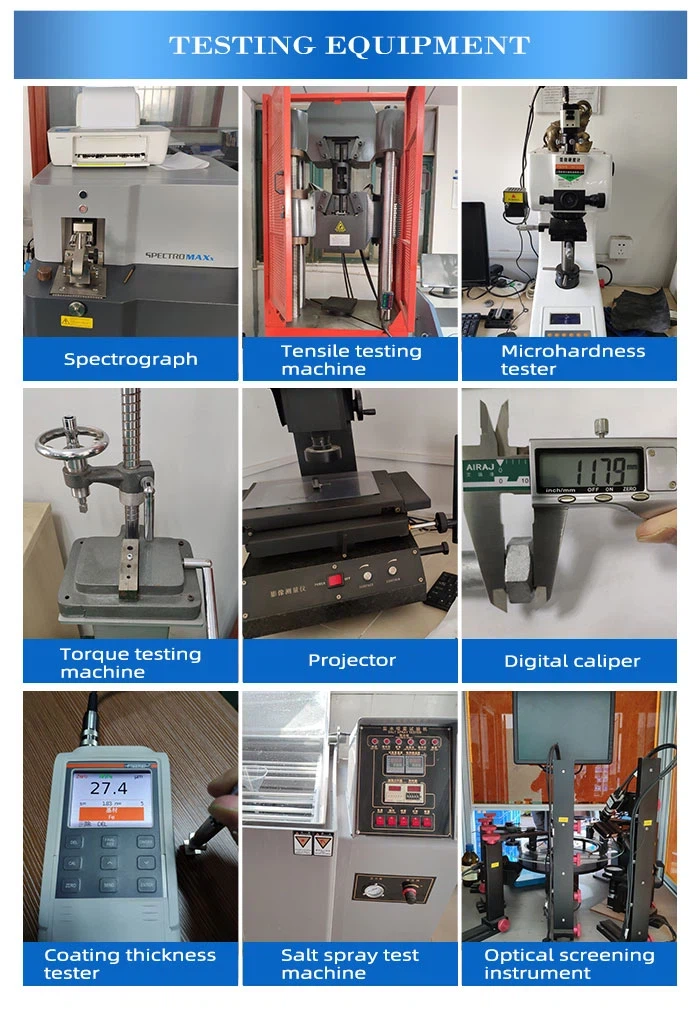
Testing Equipment
We use the following equipment to test our products to ensure they meet high quality standards:
Factory Photos
The picture below is our production workshop:

FAQ
Q: What are the common hexagonal bolt sizes?
Q: What is the difference between hexagonal bolts and heavy-duty hexagonal bolts?
Q: What is the difference between hex screws and bolts?
Q: How to judge the size of hexagonal bolts?
Q: How do I know what size hex bolt I need?
Q: Which hex bolt is the strongest?
Q: What does the bolt grade number of a hexagonal bolt mean?
Q: What does the M10 on the hex bolt mean?
Q: What does the M6 on the hex bolt mean?
Q: What are Grade 8.8 Bolts?
Q: Will hexagonal bolts rust?
Q: What do the 3 lines on the hex bolt mean?
Q: What are 10mm hex bolts?
Q: Are metric bolts stronger than standard bolts?
Q: What is the difference between grade 10.9 and grade 8.8 hexagonal bolts?
Q: What grades are there of hexagonal bolts?
Q: What are hex bolts used for?
●Within construction projects
●During the erection, repair, and maintenance of buildings, bridges, and road infrastructure
●Machinery assemblies
●Woodworking tasks such as fastening frames
●Engineering applications
●Vehicle and automotive
Q: How do hex bolts work?
Q: What do you need to consider when measuring hex bolt size and dimensions?
●The length of the bolt (measured from the end of the bolt up to under the head)
●Thread size (the size of the thread, typically using ISO metric or M-style measurements)
●Thread pitch (the number of threads per inch - the finer the bolt, the more threads per inch and the higher the thread pitch)
Q: What is ISO metric thread size system?
As one of the most professional hex bolts manufacturers and suppliers in China, we're featured by customized hardware products made in China. Please rest assured to buy or wholesale high quality hex bolts for sale here from our factory. For price consultation, contact us.
m8 hex head bolt, m5 hex head bolt, hex socket boltPopular Products


