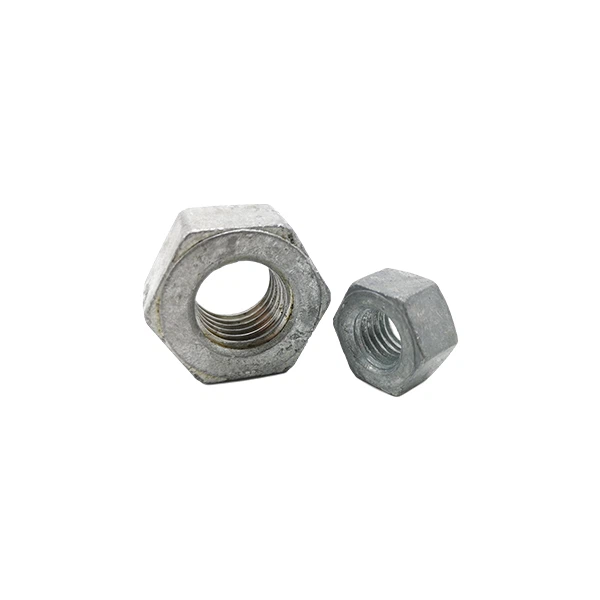
I. Nut and Bolt Mismatch
Error: Using combinations of different sizes (e.g., M16 nut with M12 bolt) or different strength grades (e.g., 8.8 grade nut with 10.9 grade bolt) results in inability to tighten properly or insufficient connection strength.
Consequences: At best, it prevents tightening; at worst, it leads to stripped threads or connection failure.
Correct Practice: Before installation, always verify that the nominal diameter (e.g., M16) and strength grade (e.g., 8.8 grade) of the nut and bolt are consistent.
II. Failure to Use Anti-Loosening Measures
Error: Using only a single nut without any anti-loosening measures in environments with vibration or alternating loads (e.g., automotive engines, mechanical equipment).
Consequences: Under prolonged vibration, the nut is prone to loosening, leading to equipment malfunction or even safety accidents.
Correct Practice: Choose an appropriate anti-loosening method based on the environment, such as using double nuts, spring washers, locking washers, or slotted nuts with cotter pins.
III. Improper Use of Installation Tools
Error: Using a wrench of the wrong size (e.g., using a 17mm wrench to tighten a 16mm nut), or applying force at an incorrect angle, causing the wrench to slip.
Consequences: Damage to the hexagonal edges of the nut, making subsequent tightening difficult; or uneven force causing thread damage (stripping).
Correct Practice: Select a wrench or socket that precisely matches the width of the opposite sides of the nut, and keep the tool perpendicular to the nut's axis.
IV. Neglecting the Quality of the Installation Surface
Error: Tightening the nut directly on a rusty, oily, uneven, or burr-covered installation surface.
Consequences: Leading to a loose connection, insufficient actual preload; or stress concentration accelerating fatigue damage to the nut and bolt.
Correct Practice: Clean and prepare the installation surface before installation, ensuring it is flat, dry, and free of oil.
V. Over-tightening or Improper Tightening Torque
Error: Over-tightening the nut by feel or brute force, without using a torque wrench to control the tightening torque.
Consequences: May lead to plastic deformation of bolt or nut threads, stripping, or even bolt breakage.
Correct Practice: For connections requiring torque, consult the technical manual and use a torque wrench for tightening.
VI. Incorrect Use of Thick Nuts
Incorrect Behavior: Believing that thicker nuts (such as Type II hex nuts) are more reliable than standard nuts (Type I), and therefore using them preferentially in all situations.
Consequences: Thick nuts result in more uneven load distribution among the threads, making them more prone to loosening.
Correct Practice: Prioritize using Type I hex nuts under standard operating conditions; use Type II or thicker nuts only in situations requiring higher strength or frequent disassembly.
VII. Ignoring Environmental Factors
Incorrect Behavior: Using ordinary carbon steel nuts without anti-corrosion treatment in humid or corrosive environments (such as chemical equipment or offshore platforms).
Consequences: Nut corrosion, jamming, or reduced strength, affecting connection reliability.
Correct Practice: Choose stainless steel nuts or carbon steel nuts with good surface treatment (such as galvanizing or Dacromet coating) depending on the environment.
VIII. Incorrect Anti-Loosening Methods
Incorrect Manifestations: Using permanent anti-loosening methods such as spot punching, welding, or gluing in areas requiring frequent disassembly; or using series steel wires for anti-loosening with incorrect winding direction.
Consequences: The former leads to irremovable parts, while the latter results in ineffective anti-loosening or even exacerbates loosening.
Correct Practice: Choose an appropriate anti-loosening method based on whether the connection requires disassembly, ensuring the steel wire is wound in the correct direction.
IX. Nut Quality Issues
Incorrect Manifestations: Purchasing and using inferior nuts with substandard materials or low thread machining precision.
Consequences: Stripping, cracking, or insufficient strength may occur during normal use.
Correct Practice: Select qualified products that meet national standards (GB/T) or international standards (ISO), and obtain a quality certificate if necessary.
10. Incorrect Installation Sequence
Incorrect Manifestation: When connecting multiple bolts, the correct tightening sequence (e.g., crisscross tightening, diagonal tightening) is not followed.
Consequences: This leads to uneven stress on the connectors, deformation, and affects connection accuracy and reliability.
Correct Practice: Follow the tightening principle of "crisscross, diagonal, in stages, and step by step" to ensure even stress distribution.