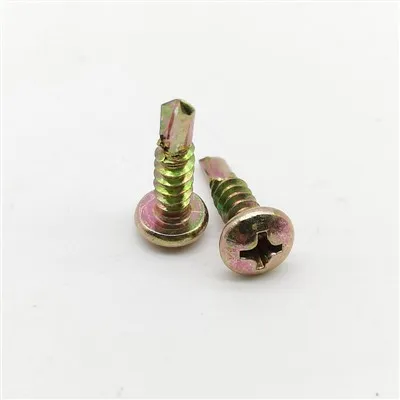
I. Choose the Right Screw Type and Match Material Properties
1. Use "Tip-Tail + Multi-Thread" Design for Plastic Parts
Tip-tail guides reduce installation deviation, and multi-thread disperses cutting force, reducing the risk of stripping. Recommended for soft plastics such as ABS and PP to avoid hole wall cracking due to stress concentration.
2. Choose "Threaded" or "Cutting" Self-Tapping Screws for Thin Metal Sheets
Threaded screws are formed by extrusion and are suitable for low-carbon steel and aluminum plates with good ductility; for thick plates or hard materials (such as stainless steel), use cutting screws with a cutting edge at the end to reduce screwing resistance.
3. Prioritize Stainless Steel Material for Outdoor/Hydraulic Environments
For example, 304 or 316 stainless steel self-tapping screws have strong corrosion resistance, preventing thread failure due to rust.
II. Control the Pre-drilled Hole and Engagement Length to Lay a Good Foundation
1. The Diameter of the Pilot Hole Should Be Appropriate: Too large, insufficient engagement; too small, easy stripping. The recommended bore diameter is 70%~90% of the nominal screw diameter, referring to standard GB/T 43655-2024.
2. Ensure effective engagement of ≥3 threads: Insufficient engagement leads to concentrated shear force and easy stripping. Especially in light metals such as aluminum alloys, it is recommended to deepen the screw hole to improve shear strength.
3. Pre-drilling is recommended for hard materials: This can significantly reduce the tightening torque and prevent screw breakage or damage to the substrate.
III. Scientifically set tightening parameters to prevent "torque overshoot"
1. Reasonable torque calculation
Use the formula:
MA = Ms + k×(MO - Ms)
Where MA is the target torque, Ms is the contact torque, MO is the breaking torque, and k is 0.3~0.5
2. Five-stage speed control (smart electric screwdriver recommended)
Nut recognition stage: <100 rpm, to prevent floating
Thread recognition stage: 200~300 rpm, to prevent misalignment
High-speed screwing: Plastic parts ≤600 rpm, aluminum parts ≤80% of process speed
Contact stage: 100~200 rpm, to ensure contact
Final tightening stage: 10~50 rpm rpm, prevent torque overshoot
3. Disable pneumatic screwdrivers, use servo electric screwdrivers instead. Pneumatic screwdrivers have uncontrollable speed and high inertia, easily causing impact and stripping; intelligent electric screwdrivers can be set with torque, angle, and stripping detection, greatly improving assembly stability.
IV. Standardize operating details to avoid human error
1. Keep screwing in vertically: tilting will cause unilateral force and local thread breakage.
2. Avoid repeated disassembly and assembly: self-tapping screws in plastic generally only support up to 8 disassembly and assembly cycles; after repeated use, the threads will be ineffective.
3. Use anti-loosening auxiliary measures: Add spring washers or toothed locking washers to key parts. Apply thread locking agent (such as Loctite 243) to achieve mechanical + chemical dual anti-loosening.
V. Strengthen incoming material and process quality control
1. Incoming material inspection: threads are complete without burrs or reverse tapers, and the major/minor diameter conforms to GB/T. 845-2017 Standard
2. Destructive Torque Test: The passing standard should be "torsion breakage" rather than "stripping" or "head breakage".
3. Salt Spray Test Verification: A coating thickness ≥ 6μm and no red rust after ≥ 200 hours of neutral salt spray testing are considered excellent.