Hey there! As a supplier of screws and bolts, I often get asked about how to determine the thread pitch of these essential fasteners. It might seem like a tricky thing to figure out, but with a bit of know - how, it's not that hard at all.
First off, let's talk about what thread pitch actually is. Simply put, the thread pitch is the distance between adjacent threads on a screw or bolt. It's a crucial measurement because it determines how well the screw or bolt will fit into a corresponding nut or threaded hole. A wrong thread pitch can lead to all sorts of problems, like the fastener not tightening properly or even stripping the threads.
Using a Thread Pitch Gauge
One of the easiest and most accurate ways to determine the thread pitch is by using a thread pitch gauge. This is a handy little tool that has a bunch of different teeth on it, each representing a specific thread pitch. You just take the gauge and try to match the teeth to the threads of your screw or bolt. When you find a perfect fit, the number on that particular tooth is your thread pitch.
For example, if you're dealing with a Pan Head Self Drilling Screws, which are great for quickly drilling and fastening into various materials, you can use the thread pitch gauge to make sure you're getting the right fit. These screws are super popular because they save a lot of time during installation, but getting the right thread pitch is still key for a secure connection.
Measuring with a Caliper
If you don't have a thread pitch gauge on hand, you can also use a caliper. First, measure the distance over a certain number of threads. Let's say you measure the distance over 10 threads. Then, divide that distance by the number of threads (in this case, 10). The result is your thread pitch.
This method works well for larger screws and bolts, like the DIN603 Zinc Plated Class8.8 M6M8M10M12 Carriage Bolts. These bolts are commonly used in applications where a smooth - topped bolt is needed, and the zinc plating gives them good corrosion resistance. Measuring their thread pitch with a caliper can be a bit more work than using a gauge, but it gets the job done.
Metric vs. Imperial Threads
It's important to note that there are two main systems for measuring thread pitch: metric and imperial. Metric thread pitch is measured in millimeters, while imperial thread pitch is measured in threads per inch (TPI).

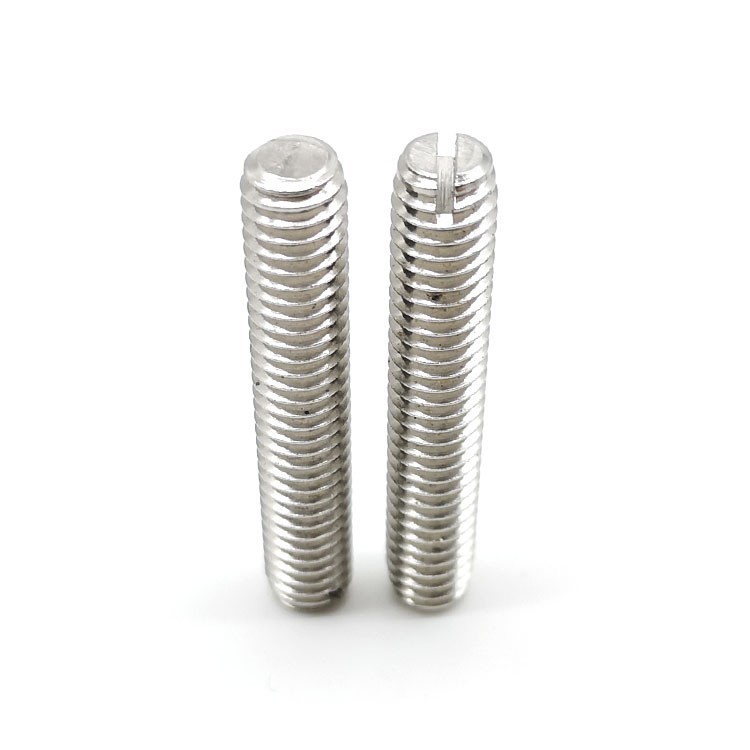
In the metric system, you'll often see screws and bolts labeled with something like "M8 x 1.25". Here, the "M8" refers to the nominal diameter of the screw or bolt, and the "1.25" is the thread pitch in millimeters. On the other hand, in the imperial system, a screw might be labeled as "1/4 - 20". The "1/4" is the diameter, and the "20" means there are 20 threads per inch.
When you're dealing with Slotted Hex Socket Set Screw With Flat Point, you need to be clear about which system you're working with. These set screws are used to hold parts in place, and using the wrong thread pitch can cause the parts to come loose.
Checking the Manufacturer's Specifications
Another reliable way to determine the thread pitch is to check the manufacturer's specifications. Most screws and bolts come with some kind of packaging or documentation that lists the important details, including the thread pitch. If you're buying in bulk from a supplier like us, we can also provide you with this information.
Sometimes, you might come across screws or bolts that are a bit more specialized or custom - made. In these cases, the manufacturer's specs are even more crucial. They can tell you things like the material, the heat treatment, and of course, the thread pitch.
Visual Inspection and Comparison
In some cases, you can also do a visual inspection and comparison. If you have a screw or bolt with a known thread pitch, you can compare it to the one you're trying to measure. Look at how the threads are spaced and try to see if they match up.
This method isn't as accurate as using a gauge or caliper, but it can give you a rough idea. For example, if you're in a pinch and need to quickly figure out if a screw will work with a particular nut, a visual comparison can help you make a decision.
Why Thread Pitch Matters
Now, you might be wondering why all this fuss about thread pitch. Well, as I mentioned earlier, the right thread pitch is essential for a proper fit. If the pitch is too big, the screw or bolt won't screw in all the way, and it won't hold tightly. If the pitch is too small, it might strip the threads in the nut or the hole.
In addition, using the correct thread pitch is important for safety. In applications where screws and bolts are holding together critical components, like in machinery or construction, a loose or poorly - fitting fastener can lead to serious problems.
Conclusion
Determining the thread pitch of screws and bolts isn't as complicated as it might seem at first. Whether you use a thread pitch gauge, a caliper, check the manufacturer's specs, or do a visual comparison, there are several ways to get the job done.
As a screws and bolts supplier, we're here to help you with all your fastener needs. If you're unsure about the thread pitch of a particular product, or if you need advice on which screws and bolts are best for your project, don't hesitate to reach out. We can provide you with high - quality products and the information you need to make the right choices.
So, if you're in the market for screws and bolts, whether it's Pan Head Self Drilling Screws, Slotted Hex Socket Set Screw With Flat Point, or DIN603 Zinc Plated Class8.8 M6M8M10M12 Carriage Bolts, give us a shout. We're ready to assist you with your procurement and answer any questions you might have.
References
- Machinery's Handbook, 31st Edition
- Fastener Standards Handbook