In the realm of industrial manufacturing and engineering, the demand for unstandard parts is ever - growing. As a supplier of unstandard parts, I've witnessed firsthand the critical role these components play in various applications, especially when it comes to shock - resistance. Designing unstandard parts for shock - resistance is a complex yet rewarding process that requires a deep understanding of materials, mechanics, and the specific needs of the end - user.
Understanding the Basics of Shock - Resistance
Shock is a sudden and intense force that can cause damage to parts and systems. In many industrial settings, such as automotive, aerospace, and heavy machinery, parts are constantly exposed to shocks. For example, in an automotive suspension system, the components need to withstand the shocks from uneven road surfaces. To design unstandard parts for shock - resistance, we first need to understand the nature of the shock.
Shock can be classified into different types, including impact shock, which occurs when two objects collide suddenly, and vibration shock, which is a continuous or intermittent shaking. Each type of shock requires a different approach to design. The key to shock - resistant design lies in the ability of the part to absorb, dissipate, or deflect the shock energy.
Material Selection
One of the most crucial steps in designing shock - resistant unstandard parts is material selection. Different materials have different properties in terms of strength, ductility, and elasticity, all of which are important for shock - resistance.
Metals are commonly used for shock - resistant parts. Steel, for instance, is a popular choice due to its high strength and good ductility. High - strength alloy steels can be further heat - treated to enhance their mechanical properties. Aluminum alloys are also favored in some applications, especially where weight reduction is a priority. They offer a good balance between strength and weight and have decent shock - absorbing capabilities.
For applications where non - metallic materials are more suitable, polymers and composites come into play. Some polymers, like polyurethane, have excellent shock - absorbing properties. They can deform under shock and then return to their original shape, effectively dissipating the shock energy. Composites, such as carbon fiber - reinforced polymers, combine the strength of fibers with the flexibility of the polymer matrix, providing a high - performance solution for shock - resistant parts.
Geometric Design
The shape and geometry of a part have a significant impact on its shock - resistance. A well - designed geometry can help distribute the shock load evenly across the part, reducing the stress concentration at specific points.
For example, rounded edges and fillets are often used instead of sharp corners. Sharp corners can act as stress concentrators, where the shock stress is much higher than in other areas of the part. This can lead to premature failure under shock. By using rounded edges, the stress is more evenly distributed, improving the part's shock - resistance.
Hollow structures can also be beneficial for shock - resistance. They can deform in a controlled manner under shock, absorbing and dissipating the energy. For instance, tubular structures are commonly used in applications where shock absorption is required, such as in the frames of bicycles and motorcycles.
Reinforcement and Support
In some cases, additional reinforcement and support structures can be added to enhance the shock - resistance of unstandard parts. This can include ribs, gussets, or internal bracing.
Ribs are thin, protruding structures that can be added to the surface of a part to increase its stiffness and strength. They help distribute the shock load and prevent excessive deformation. Gussets are triangular pieces that are used to reinforce the connection between two parts or to strengthen a corner. They provide additional support and stability, especially in areas where high shock loads are expected.
Internal bracing can be used in hollow parts to prevent the walls from collapsing under shock. This can be in the form of cross - braces or lattice structures, which help maintain the shape of the part and improve its overall shock - resistance.
Testing and Validation
Once a design for a shock - resistant unstandard part is developed, it is essential to test and validate the design. This can involve both physical testing and computer - aided simulation.
Physical testing can be done using specialized equipment, such as shock testers. These testers can simulate different types of shocks and measure the response of the part. For example, a drop test can be used to simulate an impact shock, where the part is dropped from a certain height onto a hard surface, and the damage and deformation are observed.
Computer - aided simulation, on the other hand, allows designers to predict the behavior of the part under shock without the need for physical prototypes. Finite element analysis (FEA) is a commonly used simulation method. It can model the part's geometry, material properties, and the shock load, and then calculate the stress, strain, and deformation distribution within the part. By analyzing the simulation results, designers can identify potential weak points in the design and make necessary modifications.
Specific Examples of Unstandard Parts for Shock - Resistance
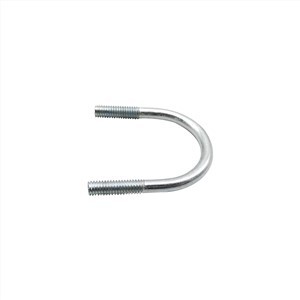
As a supplier of unstandard parts, we offer a wide range of products designed for shock - resistance. U Bolts are one such example. U bolts are often used in applications where components need to be clamped together securely, such as in automotive exhaust systems. Our U bolts are designed with the right material and geometry to withstand the vibrations and shocks from the engine and the road.
Lifting Eye Bolts are another important product. They are used for lifting heavy objects, and they need to be able to withstand the sudden shocks that can occur during the lifting process. Our lifting eye bolts are made from high - strength materials and are carefully designed to ensure even load distribution and shock - resistance.
Unthreaded Spacers are also crucial in many applications. They are used to maintain a specific distance between two components and can be exposed to shocks. Our unthreaded spacers are designed to be shock - resistant, ensuring the stability and reliability of the overall system.
Conclusion
Designing unstandard parts for shock - resistance is a multi - faceted process that involves careful material selection, geometric design, and the addition of reinforcement and support structures. By understanding the nature of shock, choosing the right materials, and applying appropriate design principles, we can create high - performance parts that can withstand the rigors of real - world applications.


If you are in need of shock - resistant unstandard parts, we are here to help. Our team of experienced engineers and designers can work closely with you to understand your specific requirements and develop customized solutions. We have the expertise and resources to ensure that our parts meet the highest standards of quality and performance. Contact us to start a discussion about your procurement needs and let's work together to create the perfect shock - resistant unstandard parts for your application.
References
- Ashby, M. F. (2011). Materials Selection in Mechanical Design. Butterworth - Heinemann.
- Dieter, G. E. (1988). Mechanical Metallurgy. McGraw - Hill.
- Megson, T. H. G. (2014). Aircraft Structures for Engineering Students. Elsevier.